It’s 11:40 p.m. The crash is over, the tow truck is gone, and you’re staring at a firm number that rings into nothing. No one picks up. The caller still has a story, a date they half remember, and a hospital name they can’t spell. Someone on your side has to own that uncertainty before morning, or the matter never reaches a lawyer at all.
Who Handles the First Call
Say a driver calls a personal injury firm after a night crash and reaches no person. The line can still start a record, but a record without an owner is just a voicemail.
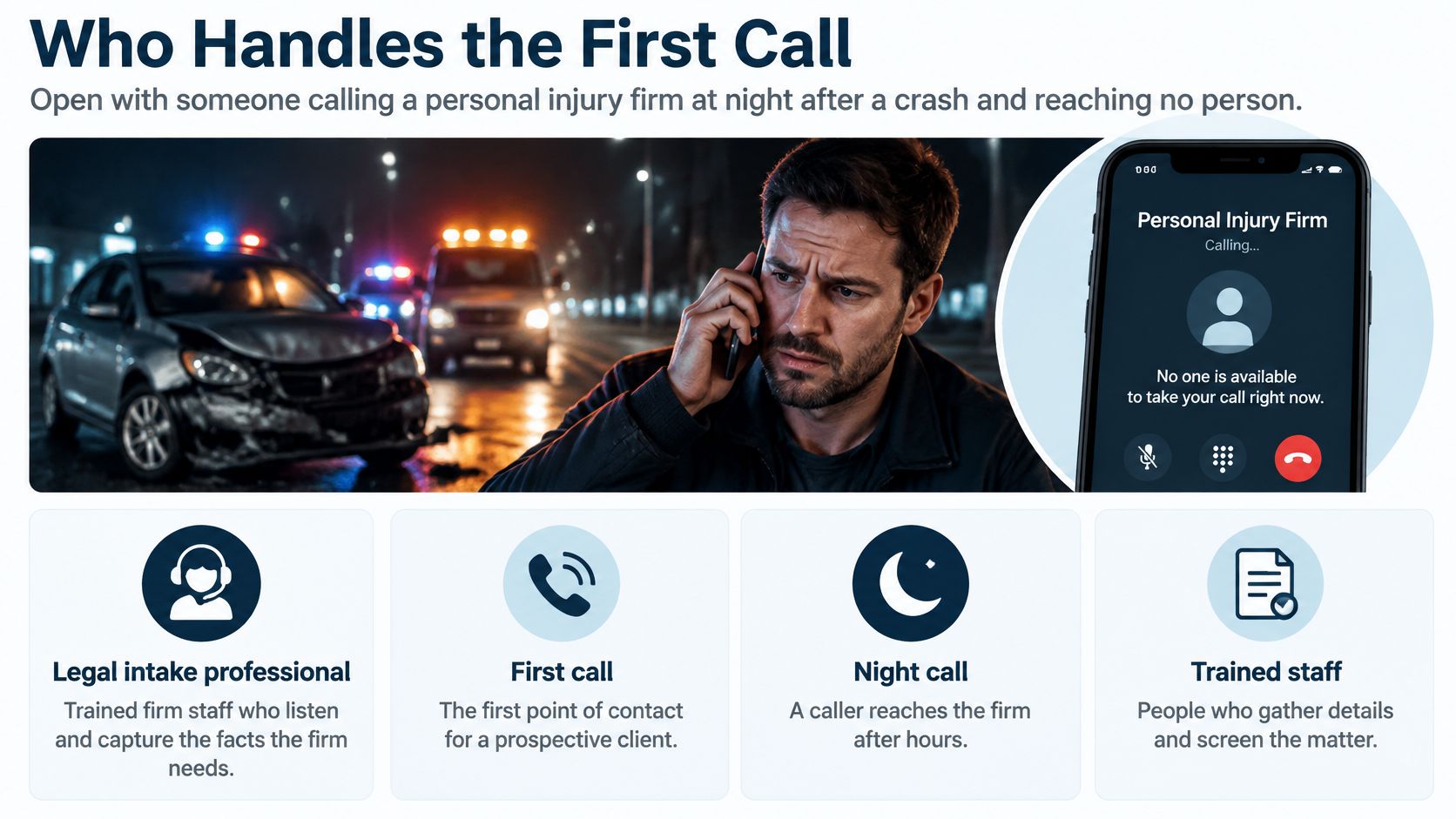
A legal intake professional is trained firm staff who listen, capture the facts the firm configured, mark what is unclear, and name the person who owns the next step. They’re the first point of contact for a prospective client, including a night call after hours. They aren’t a substitute for counsel.
In May 2024, legal-services establishments employed 281,870 paralegals and legal assistants, 124,650 legal secretaries and administrative assistants, and 24,480 receptionists and information clerks, about 431,000 support workers beside 445,990 lawyers, according to the U.S. Bureau of Labor Statistics. Intake is its own function: reception, qualification, records, and handoff. Attorneys don’t do that alone.
Think of air traffic control. The professional sequences the call and flags weather. The attorney still makes the legal judgment. If your scripts and conflict notes live in scattered PDFs, explore PDFWix for lawyers as one way to keep those working documents readable before a callback.
Three questions decide whether that night call survives until review. Which calls stay with people? Which facts make a record useful? How do you review an AI-screened call the next morning? A practical path for answering telephone calls starts with capture, not a promise. A finished intake is information for review. It isn’t acceptance of the matter.
Judgment Calls That Stay With People
The boundary you can use today is simple. The firm’s trained people decide whether to accept a matter, and they escalate legal questions to the appropriate attorney. AI can gather facts and follow configured criteria. It shouldn’t make a final legal-merit decision, calculate a filing deadline, or promise representation. That’s a workflow boundary, not a licensing rule for every jurisdiction.
| Situation | What may be gathered | Decision that stays with people |
|---|---|---|
| Uncertain or conflicting facts | Both versions, gaps, and the caller’s words | Trained staff clarify and escalate; no one invents the missing fact |
| Possible time-sensitive issue | The date and events the caller states | An attorney handles deadline analysis; staff don’t calculate or promise a filing date |
| Conflicts check | Names and details the firm’s process requires | The firm’s conflict process and the appropriate attorney |
| Engagement | Answers matched to configured criteria | The firm decides whether to accept; no one promises representation on the call |
| Legal merit | Facts needed for later review | No final legal-merit decision by AI or untrained staff |
| Caller asks for a person | The request and what was already collected | A person owns the handoff and any later advice |
Uncertain facts and time
When the story splits, write both versions and the caller’s words. Don’t pick the cleaner one. A blank date stays blank until someone asks. If the date might matter, record what the caller states and send it to an attorney. Staff don’t calculate a filing date, and they don’t tell the caller one.
Conflicts, engagement, and merit
Collect the names your conflict process requires, then follow that process. Don’t clear the matter yourself. Screening answers can match configured criteria. They can’t become “we’ll take your case” on the call. Merit stays with trained people. A request for a person is a handoff, not a cue to keep talking past the script. A human backup for an AI receptionist only works if that person is named before the call ends.
ABA Formal Opinion 512, as discussed in Business Law Today, says generative AI doesn’t create an exception to competence, confidentiality, client communication, candor, reasonable fees, or supervision. Lawyers still have to understand the tool, verify output, and avoid relying on it for professional judgment. A documented human-review checkpoint belongs before anyone acts.
Lighthouse asks a firm’s intake questions, and a completed intake doesn’t mean the firm has accepted the case. Customers remain solely responsible for legal services, attorney-client relationships, screening criteria, conflict checks, representation decisions, legal advice, deadlines, client communications, and professional duties.
Practical rule: Write the escalation owner next to each row in your own script before the next shift starts.
Skills That Shape Screening and Callbacks
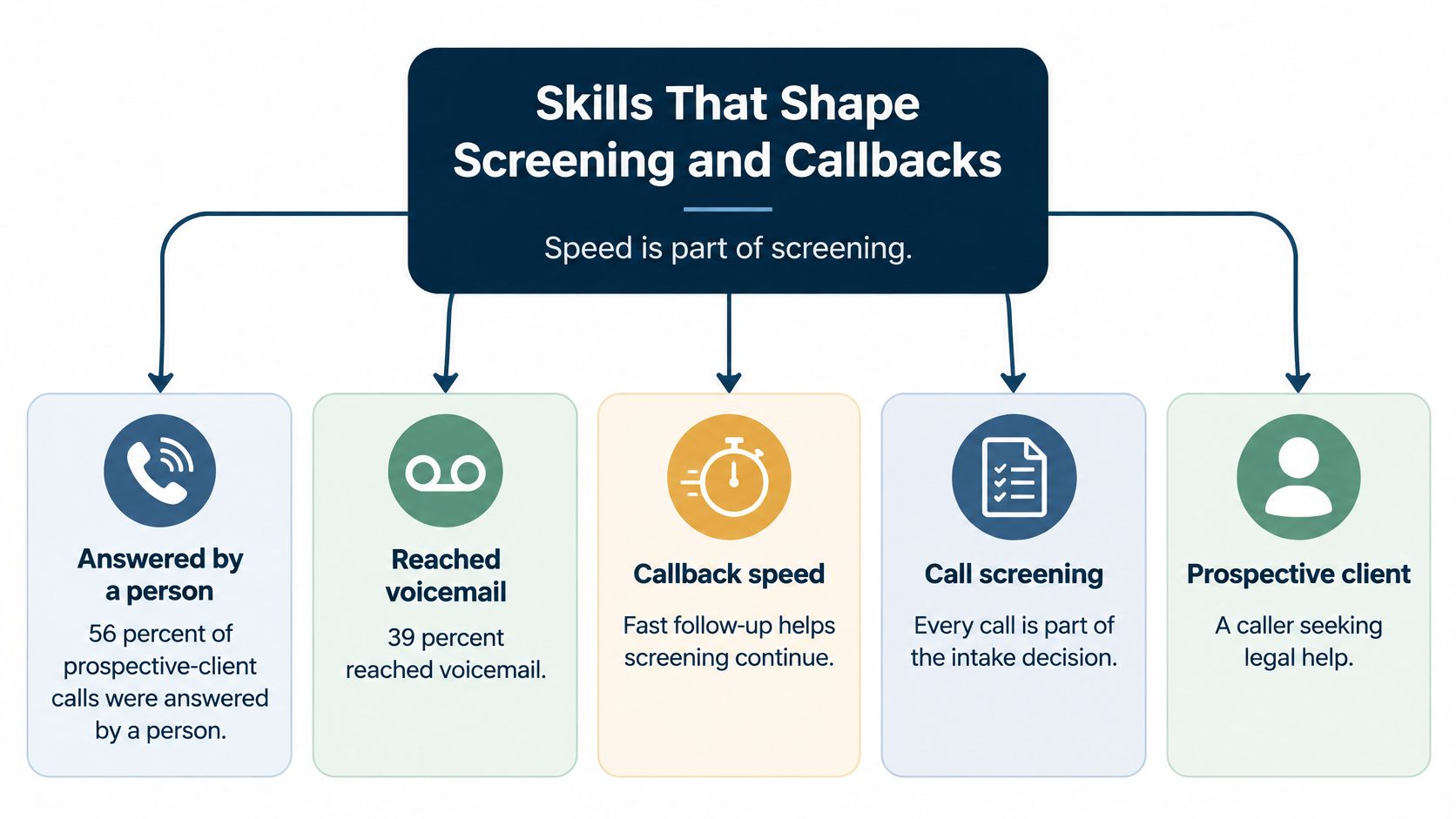
Speed is part of screening, not a courtesy score. Clio’s secret-shopper research found that only 56% of prospective-client phone calls were answered by a person, 39% reached voicemail, and more than half of firms failed to return those voicemails within 72 hours. In the same research, 82% of prospective clients considered timeliness important and 79% expected a response within 24 hours. Treat 24 hours as a ceiling for follow-up, not the goal for first capture.
| Measure | Share |
|---|---|
| Prospective-client calls answered by a person | 56% |
| Prospective-client calls that reached voicemail | 39% |
| Prospective clients who consider timeliness important | 82% |
| Prospective clients who expect a response within 24 hours | 79% |
Skills you can rehearse this week
- Active listening. Maya is upset and jumps from the crash to the hospital. You slow her down, repeat the unclear point, and you don’t give legal advice.
- Ask only the firm’s criteria. If the script doesn’t ask about prior claims, you don’t invent that question mid-call.
- Write unknown instead of guessing. “Date: unknown, between Tuesday and Wednesday night” beats a date you filled in.
- Name the callback owner. “Jordan on intake owns the morning call” is a decision. “Someone will call” isn’t.
- State only timing you can keep. If the attorney reviews after 10 a.m., say that. Don’t promise a same-night decision.
Managers can watch answer rate, abandonment, time to a human transfer, time to first follow-up, and the share of records that contain every required field. Those measures show whether after-hours demand or a thin script is dropping matters before attorney review.
Tell the caller what happens next and who owns it before you hang up.
Reaching Callers Who Cannot Use a Web Form
A web form or an answering line can’t be the only door. A 2025 New York courts technology report found that 88% of organizations still use phone-based intake and only 40% offer online intake. At the same time, 71% reported that clients lack internet access, 67% reported inadequate access to computers or smartphones, and 67% said clients are uncomfortable or inexperienced with technology.
- Offer a second try. When the phone drops, record the best number and the times that work.
- Ask about language and access early. Note a preference for another language, or help hearing or reading, so the firm can arrange support.
- Slow the pace. For limited English or a disability-related need, repeat the key facts back and wait for a yes or a correction.
- Treat the call as prospective-client contact. Under ABA Model Rule 1.18, a person who discusses possibly hiring the lawyer is a prospective client, so confidentiality applies before any engagement. Capture the names the conflict process needs.
- Track who wasn’t reached and why. If the only successful path is a stable smartphone and a long form, your own channel is screening people out.
A qualified caller who can’t finish the call isn’t a bad lead. It’s a broken route.
Four Facts That Make an Injury Record Useful
Andre says a car sideswiped him on Maple Avenue. He is unsure whether it happened Thursday night or Friday night, and he went to an emergency room whose name he cannot spell. The record can capture what he knows while keeping the uncertain details visible for the next reviewer.
Chandler Conway Law’s published result reports collecting 4 key intake facts for the firm’s review using Lighthouse. The categories below are facts a reviewer typically needs in an injury record. They are prompts for gathering information, not a guarantee that a firm will accept a case.
| Fact | What the reviewer can use | Uncertainty to flag |
|---|---|---|
| Accident type | Distinguishes among different kinds of events | Conflicting or vague descriptions of what happened |
| Accident date | Helps the attorney assess timing | Caller is unsure of the day |
| Medical treatment | Shows whether care occurred and what details are missing | Caller cannot name the provider or care |
| Incident location | Helps assess venue, jurisdiction, or firm fit | Place is incomplete or disputed |
For Andre, record the sideswipe as the reported accident type and Maple Avenue as the location given. Mark the date as uncertain. Note that emergency-room care occurred and the provider name is missing. The intake professional owns those gaps until the record is handed to the person responsible for review. No one should fill in missing details from memory or treat a completed call as an accepted case.
The next step is to route the record according to the firm’s criteria, with the uncertainty easy to see. Lighthouse can collect the intake details a firm needs and connect qualified callers to its team. Its personal injury intake questions can help a firm consider which details to ask for. People weighing when to hire a personal injury lawyer still need an attorney to review the facts and decide what happens next.
How to Review Overnight AI Call Reports
This is a recommended morning review, not an observed customer routine and not a universal rule. Automated output is triage. Lawyers stay accountable for AI-assisted work, and the check should match the task, as the WashU Law legal ethics resources frame supervision.
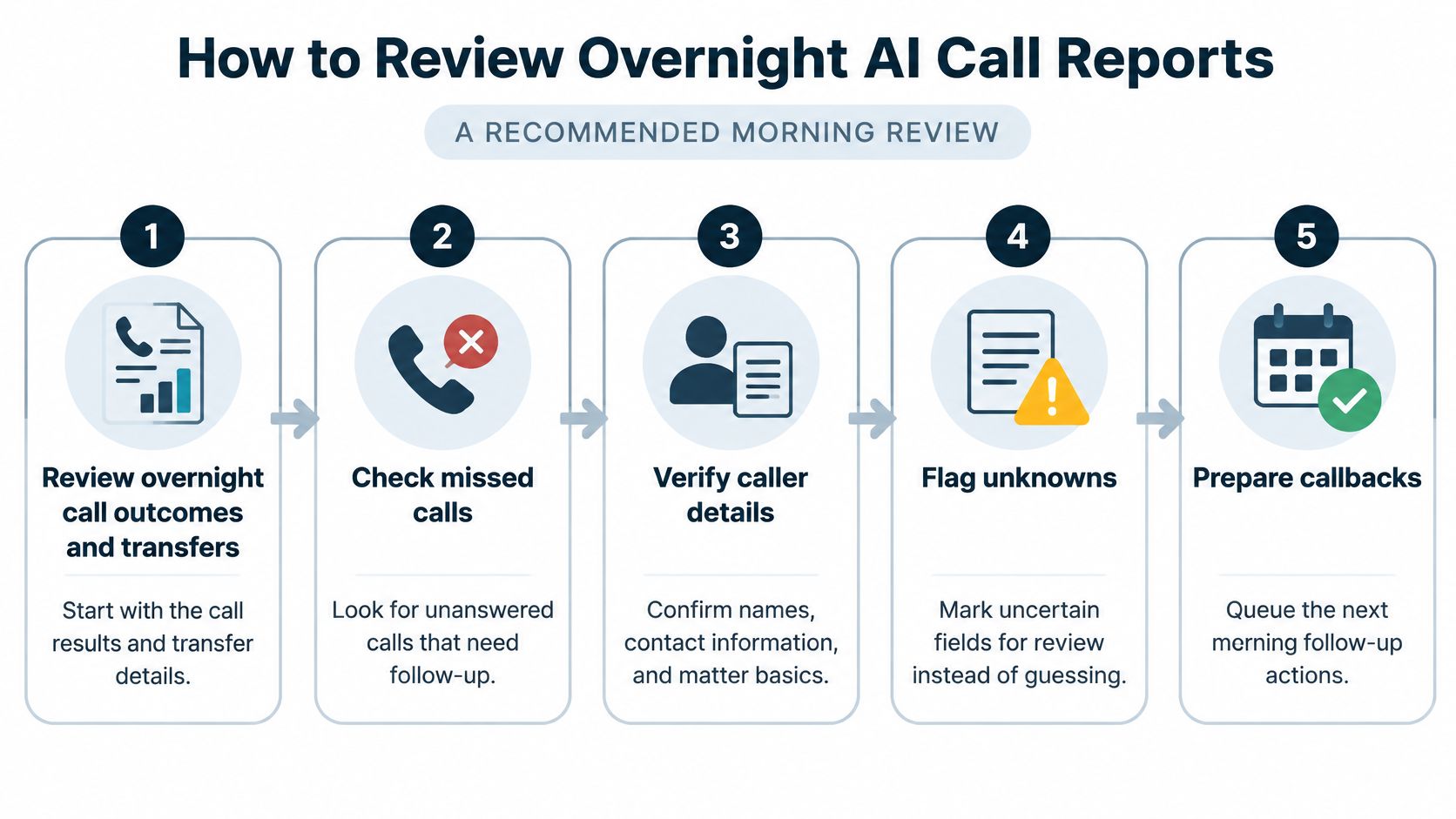
Lighthouse saves intake fields, a summary, and the transcript of the conversation it handles. The report prioritizes attention. The transcript is what you open when facts are incomplete or consequential. The same habit applies when you’re scrutinising AI-generated training content: don’t rubber-stamp a short version of a longer source.
Six moves, in order
- Review overnight outcomes and transfers first. Start with calls marked qualified, urgent, incomplete, or requesting a person.
- Read the extracted details and the summary before you open anything longer.
- Open the transcript only when you need it. Context or exact wording, conflicting facts, unclear urgency, or routing that doesn’t match the firm’s criteria.
- Listen to the relevant recording if the transcript seems wrong.
- Clarify with the caller when an important fact is still unknown.
- Assign a callback owner using the firm’s own process.
A blank date
Priya’s summary says rear-end crash and emergency treatment. The date field is blank. You don’t type a weekday because the summary feels complete. You open the transcript, hear an unclear weekday, and assign the callback. The published Chandler Conway story supports gathering details for attorney follow-up. It doesn’t support invented analytics or a script of specific staff actions.
Saved fields, a summary, and the transcript are triage material. They aren’t a signed case, and they aren’t a deadline opinion.
Training Staff to Follow Up After Screening
A caller says they were treated, but the transcript only shows that they plan to see a doctor. Train staff to check the transcript against each field before deciding what to do next. An uncertain field belongs on the callback list, not in the record as a guessed fact.
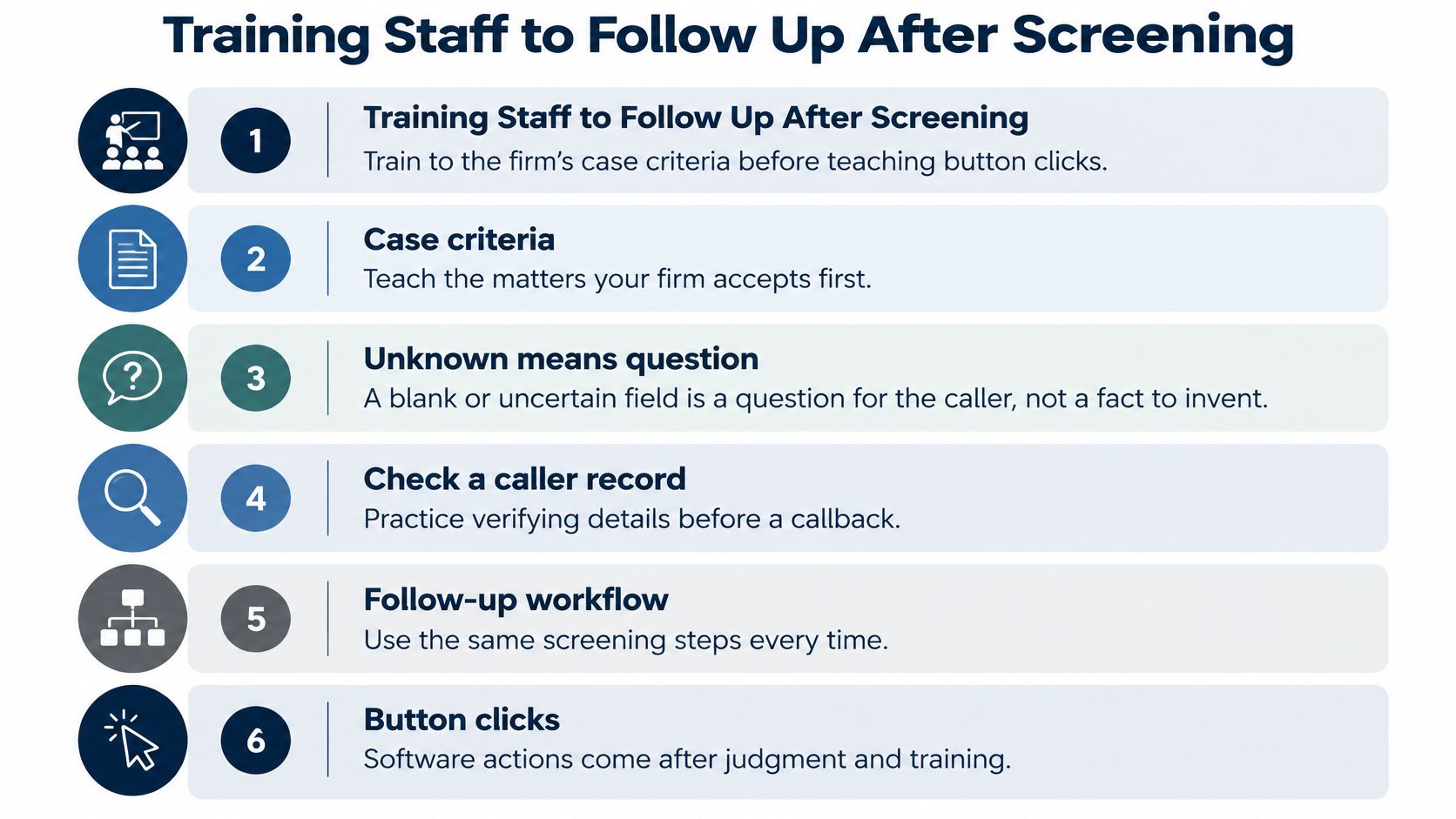
Check the condensed field
Use a fictional caller, Luis. His summary says he received treatment, but the transcript says he plans to see a doctor. Ask, “Have you already been seen, or is that visit still ahead?” Record the answer the firm’s criteria require, then stop. The callback is for clarifying intake facts, not conducting a medical interview.
Have staff practice pointing to the transcript line that supports each field. If there is no supporting detail, mark the field unknown and assign someone to follow up.
Two handoff drills
Practice a caller’s request to speak with a person and a transfer that goes unanswered. For each drill, name the callback owner, the escalation path, and any timing staff can keep. For example: “Sam returns this by 10 a.m. If Sam is out, Riley takes it.” A clear handoff works like a relay: the next person knows the task and when it is due.
A completed intake does not mean the firm has accepted the case. Lighthouse saves intake fields, a summary, and the transcript of the conversation it handles. Confirm with Lighthouse and the firm’s phone system what is recorded after a transfer, so staff know which record to check for the later conversation.
Product output is a working aid, not legal advice or a factual finding. A qualified attorney must independently review and approve output before anyone relies on it for a legal, ethical, regulatory, or client-facing purpose.
Supervision still sits with the firm
Washington State Bar Association ethics guidance discusses lawyers’ responsibilities for understanding a tool’s confidentiality, security, retention, and vendor terms, as well as supervising staff and providers. Callers may share sensitive facts before any engagement. The firm still needs to decide how those details are handled.
Use a short practice session: one clear handoff, one unanswered transfer, and one unknown date. End by having staff name who owns each follow-up.
Confirm the Next Owner Before You Change Coverage
Write three lines before you buy or expand any answering setup.
- Who decides acceptance. Name the person, not the software.
- Who is called when facts conflict or a date might matter. That’s the escalation path.
- Which fields must be present before a callback. If date or treatment is blank, the callback exists to fill it.
Nights, weekends, overflow, and routine screening can be covered without replacing the intake team. Lighthouse covers those windows and doesn’t replace the firm’s intake team. The people who already own uncertainty still own it.
If you want to test AI answering, bring your current intake questions to a demo, try example calls with made-up case details, and review the transcript and report against the judgment table and the four injury facts. You can use that same conversation to discuss after-hours or overflow coverage. The fit check is narrow. Can a caller leave a complete, reviewable record, and can a named person still own merit, conflicts, deadlines, and any promise of representation?
Pick one overnight or overflow window this week. Run the morning review on those calls. Keep the engagement decision with the firm’s trained people.
Lighthouse Legal builds customizable AI voice intake for personal injury firms, so nights and overflow still capture the firm’s questions and a reviewable record. The intake professional keeps uncertainty, conflicts, and the decision to accept. Visit Lighthouse Legal to bring your current questions to a demo and hear how a made-up call is summarized before anyone promises representation.