The phone rings while you’re with a client, and the note that lands in the queue is three vague lines. Staff open it and face one question: can they act without replaying the recording? A useful intake summary example separates urgency, stated facts, unknowns, and ownership, so the next person knows the move. Speed is part of that job. A 2024 secret-shopper study of 500 law firms found that only 40% answered a prospective client’s telephone call, and 79% of legal consumers expect a response within 24 hours, per the GB Advisors intake review. If the note doesn’t say who calls back, what is still missing, and whether the matter fits the firm, that window closes. The five labeled fictional records below are decision-ready samples, not scripts. A guide to intake automation for clinics shows the same discipline on a form. Adapt the fields to injury calls.
1. Motor Vehicle Accident Inquiry Intake Summary (Labeled Fictional, Redacted)
FICTIONAL, MVA inquiry. Caller: [NAME REDACTED]. Callback: [NUMBER REDACTED]. Incident: motor vehicle collision, previous day, within the firm’s service area. Stated status: caller reports they are receiving urgent care. Routing: flagged for staff review. Next step: staff to call back and confirm details. No fault finding. No case-value comment.
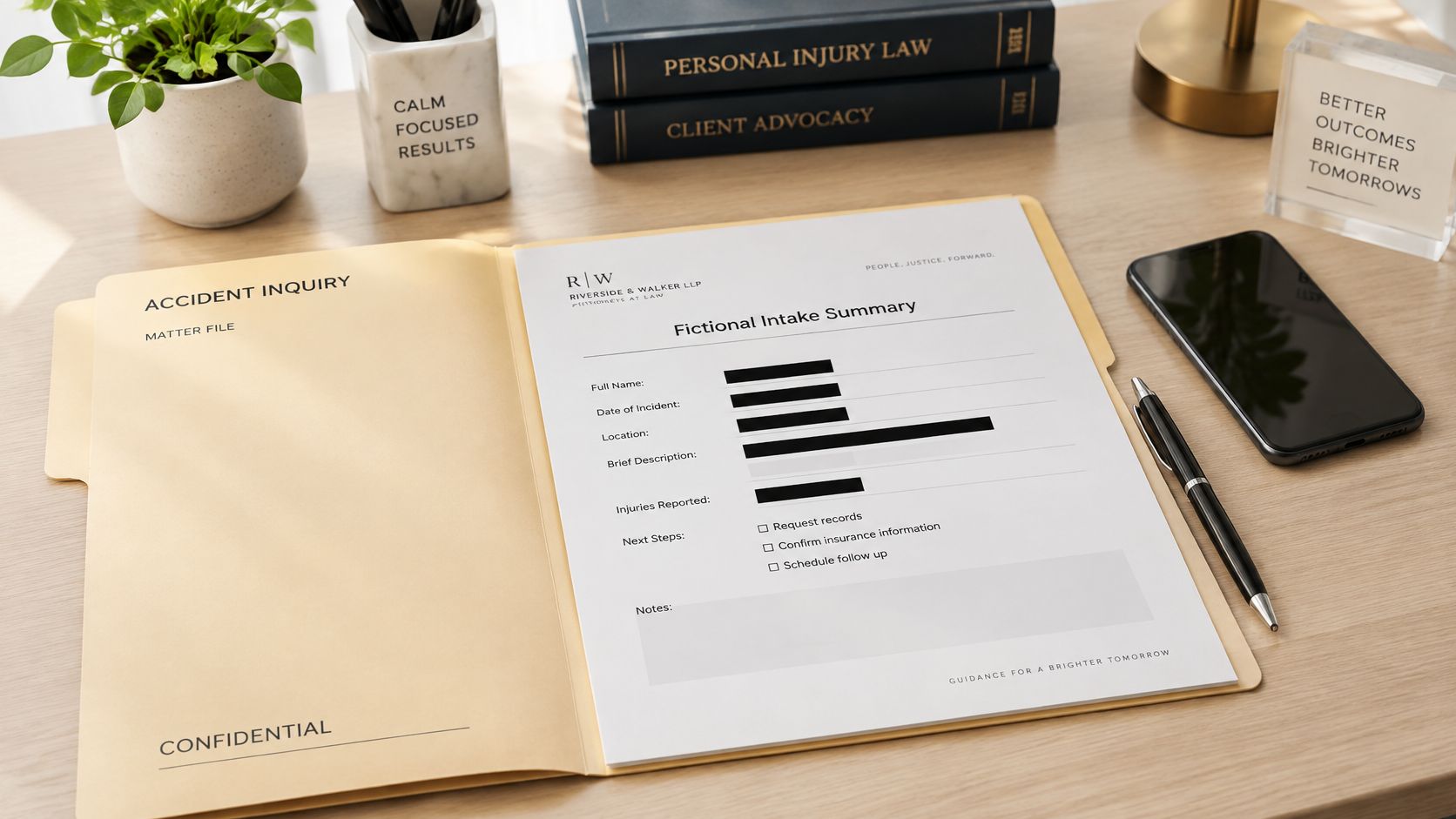
That block is enough for a same-day callback. It doesn’t pretend the firm has screened conflicts or accepted the case. The ABA client-intake excerpt says initial phone screening should first determine whether the matter is the type the firm handles, then run a conflict check, and it cautions against collecting excessive detail because extra names can create more conflict exposure.
What Each Field Does on a Crash Call
Caller and callback sit in their own fields so nobody hunts a paragraph for the number. Incident holds only what the caller stated: collision, yesterday, inside the service area. Stated status stays in the caller’s frame. “Receiving urgent care” is not a diagnosis and not proof of damages.
Routing tells the reviewer this isn’t a decline. Next step names the action, a callback to confirm details, without promising representation.
Practical rule: Quote the caller’s words for symptoms or treatment when you can, and confirm date and location on the callback. Those two facts decide whether the matter is even in criteria.
Build the same record by locking Client Name and Phone Number as required, then adding Date of Accident, Incident Location, and a broad Medical Treatment type. Don’t paste a full chart into the first note.
2. Call Outside Firm Criteria Summary (Labeled Fictional, Redacted)
A decline that isn’t written down gets relitigated every Monday. Write the mismatch in one sentence and stop.
FICTIONAL, outside criteria. Caller seeks help with a family law matter. This firm doesn’t handle that practice area. Stated reason: custody dispute after a separation, no injury claim. Outcome: caller received the firm’s standard referral statement. No transfer. Owner: intake. Next step: none. Close the record.
An analysis of 3.2 million new-business calls involving 4,210 U.S. law firms, covering June 2022 through July 2026, found personal-injury firms connected only 20.6% of qualified leads through a consultation booking or live transfer. Firms with consultation scheduling connected 69.3% of qualified leads, compared with 15.3% where scheduling was unavailable, in the Scaling Law Firms intake analysis. Booking only works after the screen. Sending a non-injury caller into that path wastes the slot and the caller’s time.
How to Record a Clean No
- Name the mismatch: One sentence, the practice area they asked for and the practice area you don’t take.
- Save the wording you used: The referral line or the polite decline, so every shift sounds the same.
- Skip the transfer: If criteria say no, don’t warm-transfer “just in case.”
- Review the pile: Look at declined calls on a set day and check that criteria still match what the firm files.
A short decline is kinder than a long interview that ends in the same no.
If overflow staff or a call center for lawyers takes the first pass, give them the decline script in writing. A completed screen still doesn’t mean the firm accepted a case. It means someone applied your rules and wrote down the result.
3. Intake Summary with Unknown Key Facts (Labeled Fictional, Redacted)
Empty fields get filled in by memory. Unknown does not.
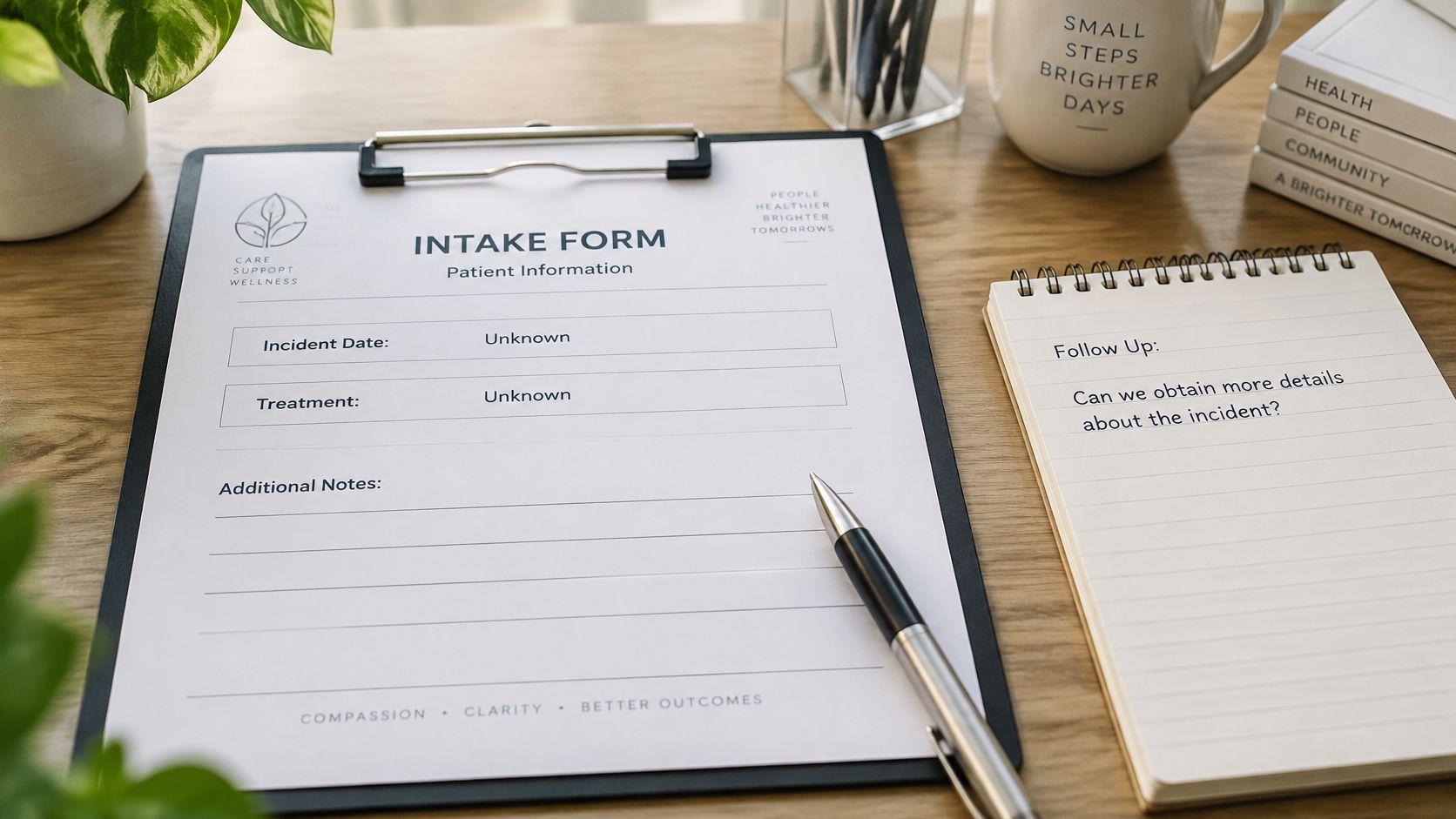
FICTIONAL, facts incomplete. Caller statements: rear-end crash, “my neck is sore,” wants a lawyer, callback captured. Incident date: UNKNOWN. Treatment status: UNKNOWN. Staff conclusion: none. The call doesn’t establish venue, deadline pressure, or medical care. Follow-up question, ask it as written: “On what date did the incident occur, and have you received any medical treatment since then?”
Say a caller is upset and jumps from the tow truck to the insurance adjuster. Staff who type “last week” or “went to the ER” because it sounds likely have just invented the two facts that decide whether you keep the lead. Leave the blanks labeled.
Keep Statements Apart from Conclusions
Use three labels every time. Caller stated holds quotes and dates they gave. Unknown is the word you type, not a blank that looks like a software glitch. Staff conclusion stays empty until a person verifies something. A shorter note isn’t safer if it deletes the uncertainty.
The ABA’s generative AI ethics note says lawyers remain responsible for confidentiality safeguards, that informed consent may be required before confidential information goes into a third-party AI system, and that generic boilerplate consent may not be enough. If a tool drafted the summary, add process metadata: channel, whether the caller was told, consent status, human reviewer, and what still needs confirmation.
- One question per follow-up: Staff can read it aloud. Don’t bundle five issues into a paragraph.
- Don’t infer treatment: Soreness isn’t a visit. Medical Treatment should record a broad type only after the caller says it.
- Match questions to criteria: A personal injury intake question list belongs in the script, not as legal advice in the summary.
4. Priority Staff Review Summary (Labeled Fictional, Redacted)
Put the handoff on the first lines. Everything else can wait.
FICTIONAL, prompt review. Caller: [NAME REDACTED]. Callback: [NUMBER REDACTED]. Urgency stated: urgent. Requests a person. Transfer: attempted, not completed. Accident date: UNKNOWN. Treatment: UNKNOWN. Owner: intake manager. Next step: return the call the same business day and confirm the incident date at the callback number. No advice given.
Research on 1,333 law firms in 2025 found a median response time of 13 minutes among firms that responded to online leads, while 26% didn’t respond at all and only 25% replied within five minutes, according to CaseQube’s intake benchmarks. A priority flag without an owner is just a brighter version of nonresponse.
What the Reviewer Needs in the First Pass
The ABA young-lawyer intake guide says conflict checking should happen before legal advice and before an engagement letter, and that you may need the potential client, the legal area, the general dispute, the opposing party, and where a case is or may be pending. Detail you do collect stays confidential under the prospective-client duties in Model Rule 1.18.
- Callback and urgency first: Don’t bury the number under a narrative.
- Transfer outcome immediately: Write it when the attempt fails, not from memory an hour later.
- One owner, one action: “The team will look” stalls. A named person and a same-day callback doesn’t.
- Unknowns stay visible: Missing date and treatment are reasons to call, not reasons to guess.
I recommend you treat “I want a person” as its own field. A failed transfer plus that request is a callback, not a voicemail to sort tomorrow.
5. After-Hours Recorded Intake Summary (Labeled Fictional, Redacted)
FICTIONAL, after hours. Received Saturday evening. No staff on the line. Caller gave a name, callback, and a short account of a parking-lot collision. Recording and transcript attached. Medical urgency: caller didn’t describe emergency care. Flag: review next business day at the fixed morning slot. Callback stored in its own field. Decision on criteria: not made.
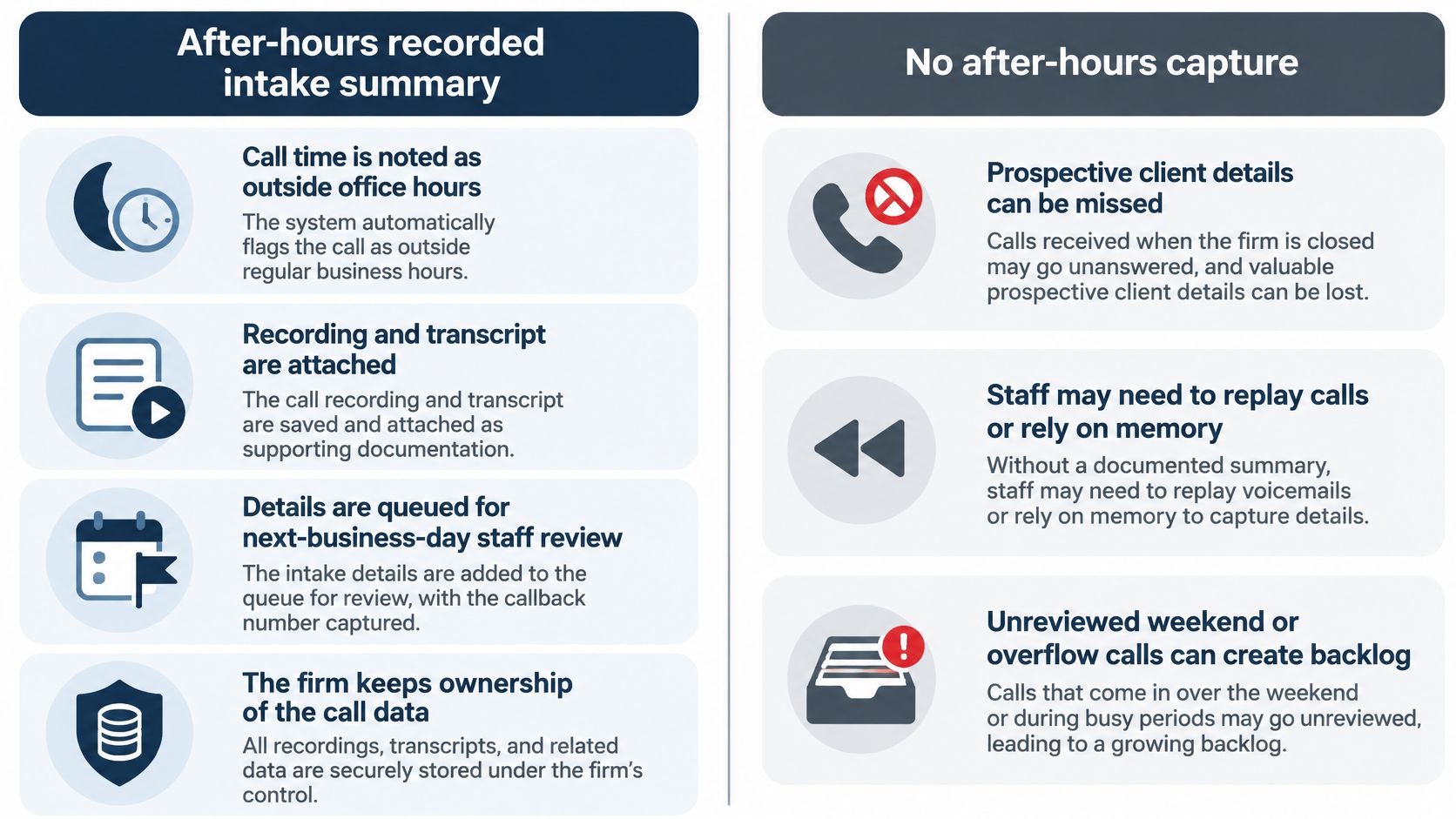
Continuous answering can hold the facts until Monday. It can’t accept the case, run conflicts, or promise a result. The Saturday note should look thinner than a weekday consult, and that’s the point. Staff still own the screen.
What to Check Before You Rely on the Transcript
Spot-check the recording against the text for names, dates, and phone numbers. Those three often fail, and a wrong digit means the morning callback never connects. If the caller describes urgent medical needs, pull that summary out of the Monday pile and mark it for same-day review, even when the office was closed.
Set one clock time for the after-hours queue. Rotating “whoever is free” is how Saturday calls sit until Wednesday. Keep preferred language on the record when the caller struggled in English, and don’t normalize their account into cleaner facts than they gave.
Whether you may record, and what you must say first, depends on the state and on how the line is set up. Read a plain guide to call recording legality before you attach audio to the file, and store the disclosure you used next to the transcript.
What each intake summary example is built to do
| Item | Primary Use | Key Fields Highlighted | Who Acts Next |
|---|---|---|---|
| Motor Vehicle Accident Inquiry Intake Summary | Capture and route a time-sensitive accident inquiry | Incident type, timing, service-area location, reported urgent care, callback number | Staff call back and confirm details |
| Call Outside Firm Criteria Summary | Document screening of inquiries outside the firm’s practice areas | Requested practice area, mismatch with firm criteria, referral or decline action | No follow-up unless firm policy requires it |
| Intake Summary with Unknown Key Facts | Record incomplete information and identify what needs confirmation | Unknown incident date and treatment status, caller statements, follow-up questions | Staff ask the listed follow-up questions |
| Priority Staff Review Summary | Triage an urgent inquiry and assign accountable follow-up | Caller and callback details, stated urgency, uncertain facts, transfer outcome, owner, next step | Assigned owner contacts the caller promptly |
| After-Hours Recorded Intake Summary | Capture calls received outside office hours for later review | Call time, recording and transcript, intake details, callback number, review flag | Staff review on the next business day |
Turn These Examples Into Your Own Intake Standard
Take the five records and turn them into a firm standard before you change the live line. List the fields you always need: name, callback, incident type, date, location, a broad treatment note, referral source, criteria result, and one next step. Define which outcomes get a same-day owner. A stated emergency, a requested person, a failed transfer, and an after-hours medical flag belong on that list. A clean decline doesn’t.
Test with sample calls and made-up facts before you touch real leads. Read the summary the way a colleague would at 8 a.m. If you can’t tell what to do, the template failed, not the caller. Keep caller statements, unknowns, and staff conclusions in separate labels so a later review doesn’t treat a guess as a fact.
Lighthouse Legal can sit in that test. Prospective customers can bring their current intake questions to a 15-minute demo, try example calls with made-up case details, then review the transcript and report before deciding what to change. A completed intake still does not mean the firm has accepted the case. Pair the new summaries with SEO tactics for attorney lead flow only after the callback path works. More leads on a vague note just make a longer queue.
Lighthouse Legal runs customizable AI voice intake for personal injury firms, screening callers against your criteria and saving the intake fields, a short summary, and the full transcript for staff review. It covers nights, weekends, and overflow without replacing your intake team, and it transfers qualified callers or anyone who asks for a person. Visit Lighthouse Legal to book a 15-minute demo and try the summary on made-up case details before you change your line.