Recording a call is generally legal under U.S. federal law when at least one participant consents, but 38 states plus the District of Columbia follow one-party-consent rules, while 11 states require consent from every party. Because callers and businesses may be in different states, the safer working rule is to give clear notice at the start of each recorded call and obtain consent before collecting substantive information.
A personal injury firm preparing to record intake calls can’t assume that its own state’s rules settle the question. A caller may be somewhere with stricter requirements, and a first conversation may involve someone who isn’t a client at all. The practical questions are which consent standard applies, what notice the caller needs, and what the firm will do if the caller objects.
This is practical compliance guidance, not legal advice. Have counsel assess the firm’s actual call types, participant locations, and recording workflow before launch. Firms comparing phone systems across borders may also find this overview of reliable VoIP options for Canadian SMBs useful, though choosing a phone provider doesn’t resolve recording-law obligations.
The Short Answer on Call Recording Legality
A caller reaches your intake line, hears a brief recording notice, and says “I’d rather not be recorded.” What happens in the next ten seconds matters more than the notice itself.
The short answer: recording a call is generally lawful when at least one participant consents. A minority of states goes further and requires agreement from everyone on the line, and state-by-state guides such as the Digital Media Law Project’s recording-law survey reflect that split. Because an intake caller can dial in from anywhere, the safer practice is to apply the stricter standard by default: announce the recording, confirm consent, then proceed.
That framework is sound as far as it goes. The problems that trip up intake-driven firms sit just outside it:
- The caller isn’t a client yet. Confidentiality duties can attach before anyone signs an engagement letter, so a recording may capture protected information from a person who never hires the firm.
- Recording consent and AI disclosure are separate questions. A caller can validly agree to recording while a different rule governs whether the firm must disclose that an AI tool is screening, transcribing, or summarizing the call. Passing one test does not satisfy the other.
- Objections need an operational path. Where consent is the legal basis for recording, a caller’s refusal cannot be a dead end. Staff need a defined next step, whether that is an unrecorded line, a callback, or a web form.
None of these questions is settled by the phone system itself. Firms weighing platforms, including shops with cross-border callers, sometimes start with reliable VoIP options for Canadian SMBs and layer a recording policy on top. The provider decision and the consent analysis run on separate tracks, and counsel should approve the actual policy before the first call is recorded.
How Federal Law Treats Recorded Calls
The federal baseline comes from the Wiretap Act. Recording is generally lawful when the person recording is a party to the call, or when at least one participant has consented beforehand. A firm recording its own intake line satisfies that test on its face, because the firm is on the call and therefore counts as a consenting party. (18 U.S.C. § 2511)
Two limits sit inside that baseline. The statute bars interception carried out to commit a separate criminal or tortious act, so a recording that looks procedurally fine can still violate federal law if the purpose behind it is improper. The penalties are also real: violations can carry up to five years’ imprisonment, and 18 U.S.C. § 2520 gives the person who was recorded a civil claim for damages.
Federal consent law asks who agreed to the recording, not who the caller is. A first-time intake caller is not yet a client, and the statute does not treat that call differently because of it.
Practical rule: Treat the federal standard as a floor, not a nationwide approval. A recording process that fits federal law may still fail a stricter state rule.
Why the federal rule isn’t the last word
State laws can demand more than federal law, and an interstate call can pull in more than one jurisdiction at once. The FCC has warned that some state rules are stricter than the federal baseline and that recording across state lines can create a genuine conflict about which law applies. A firm should not assume recording is lawful just because its own location permits it. (Justia’s 50-state call-recording survey)
The federal rule is also silent on questions a modern intake line has to answer anyway. It does not tell the firm whether the voice on the line must be identified as software rather than a person. It does not say what to do when a caller refuses to be recorded.
Federal law gives a firm room to record. It does not write the script, set the timing, or supply a fallback when the caller says no.
One-Party and All-Party Consent Rules by State
Call a prospective client in Los Angeles from an intake desk in Houston and two different consent standards sit on the same line. Texas generally lets one participant record. California expects consent from everyone on the call. Which rule governs an interstate intake call is a question for counsel to settle before the first recorded conversation, not after a complaint.
A widely cited 50-state survey from the Digital Media Law Project divides the country into two camps. Most states, plus the District of Columbia, follow one-party consent, meaning a participant in the conversation can generally record it. A smaller group requires consent from every party. That group includes California, Connecticut, Florida, Illinois, Maryland, Massachusetts, Montana, New Hampshire, Pennsylvania, and Washington, though courts sometimes read these statutes differently depending on whether the conversation counts as private or confidential.
| Consent standard | What it requires | Where it applies | Safest practice |
|---|---|---|---|
| One-party consent | At least one participant in the conversation agrees to the recording. | Most U.S. states and the District of Columbia. | Give notice at the start of the call anyway; it creates a record and costs little. |
| All-party consent | Every participant must agree before recording is lawful. | A minority of states, including California, Florida, Illinois, Massachusetts, and Pennsylvania. | Pause substantive intake until the consent step your counsel approves is complete. |
Washington’s statute, for instance, requires prior consent from all participants before recording a private telephone communication. Statute lists also drift as legislatures amend wiretap laws, so treat any table, this one included, as a starting map rather than authorization.
One wrinkle intake teams miss: the prospective client calling for the first time gets no cushion from an engagement letter or an existing relationship. The same consent duties apply to that call, and the confidentiality stakes are arguably higher if the firm later declines the matter.
Why a firm’s location isn’t enough
Your office address doesn’t settle which standard applies. The caller, your firm, and the answering agent may each sit in a different state. A phone area code is also unreliable evidence of where someone answers, and the accident location doesn’t determine which recording law governs.
Don’t build a consent policy around guessing where a caller is. Have counsel assess the locations, call type, and applicable statutes, then approve the notice language and the objection process.
The conservative posture is clear notice at the start of every recorded call, with the all-party standard as the working default for interstate intake. The cost of over-consenting is one spoken sentence. The cost of guessing wrong can be an inadmissible recording and a statute citation, so confirm the default with counsel rather than trusting a generic script.
Recording Laws Outside the United States
An intake line can pull a firm into foreign rules faster than it expects. A former client calls from London, a referral rings from Toronto, or a vendor stores recordings on servers abroad, and the U.S. consent analysis stops being the whole answer.
In much of Europe, guidance from the European Data Protection Board expects businesses recording customer calls to tell callers why the call is recorded, who will receive the recording, and how they can object or request access. A bare “this call may be recorded” line, standard on many U.S. intake scripts, does not meet that fuller notice expectation on its own.
The United Kingdom has a framework for certain business recordings. Permitted purposes under the relevant regulations include establishing facts, checking regulatory compliance, training, preventing or detecting crime, and investigating unauthorized system use. The regulations came into force on 27 June 2018. Those defined purposes show why “we keep calls because they might be useful” can fall short where extra data-protection duties apply. (UK business monitoring and record-keeping regulations

Purpose, notice, and data handling
Canada’s privacy regulator takes a similar purpose-based approach for customer calls governed by PIPEDA. An organization should explain why it is recording, use the recording for a purpose a reasonable person would consider appropriate, and obtain meaningful consent. Continuing after a caller has been informed may establish implied consent when the caller understands the recording and its purpose. (Office of the Privacy Commissioner of Canada guidance)
The operational pattern repeats across these regimes: state a specific purpose, say who may receive the recording, offer clear routes to object or request access where applicable, and restrict who can listen and how long files are kept. A firm can adopt those safeguards as an internal baseline even for calls that never leave U.S. jurisdiction.
That baseline still needs a legal check. Cross-border intake raises questions a generic script cannot settle, including which country’s rule governs a non-client caller and where recordings may lawfully be stored. Have counsel confirm the firm’s exposure before the line goes live.
Recording Consent Is Not the Same as AI Disclosure
A recording announcement and an AI introduction answer different questions. Saying a call is recorded doesn’t tell the caller whether an AI system is handling it. Saying an AI system is involved doesn’t tell the caller that the conversation will be recorded, transcribed, or retained. Firms should review these as separate disclosures rather than assuming one covers both.
Utah provides a concrete example of why the distinction matters. Under Utah Code § 13-77-103, effective May 7, 2025, a supplier using generative AI in a consumer transaction must disclose AI involvement when the person clearly and unambiguously asks whether they’re interacting with AI. The statute also sets disclosure requirements for certain high-risk AI interactions involving regulated services, including a verbal disclosure at the start of a verbal interaction. These duties are conditional and don’t create a universal rule for every call. (Utah Code § 13-77-103)
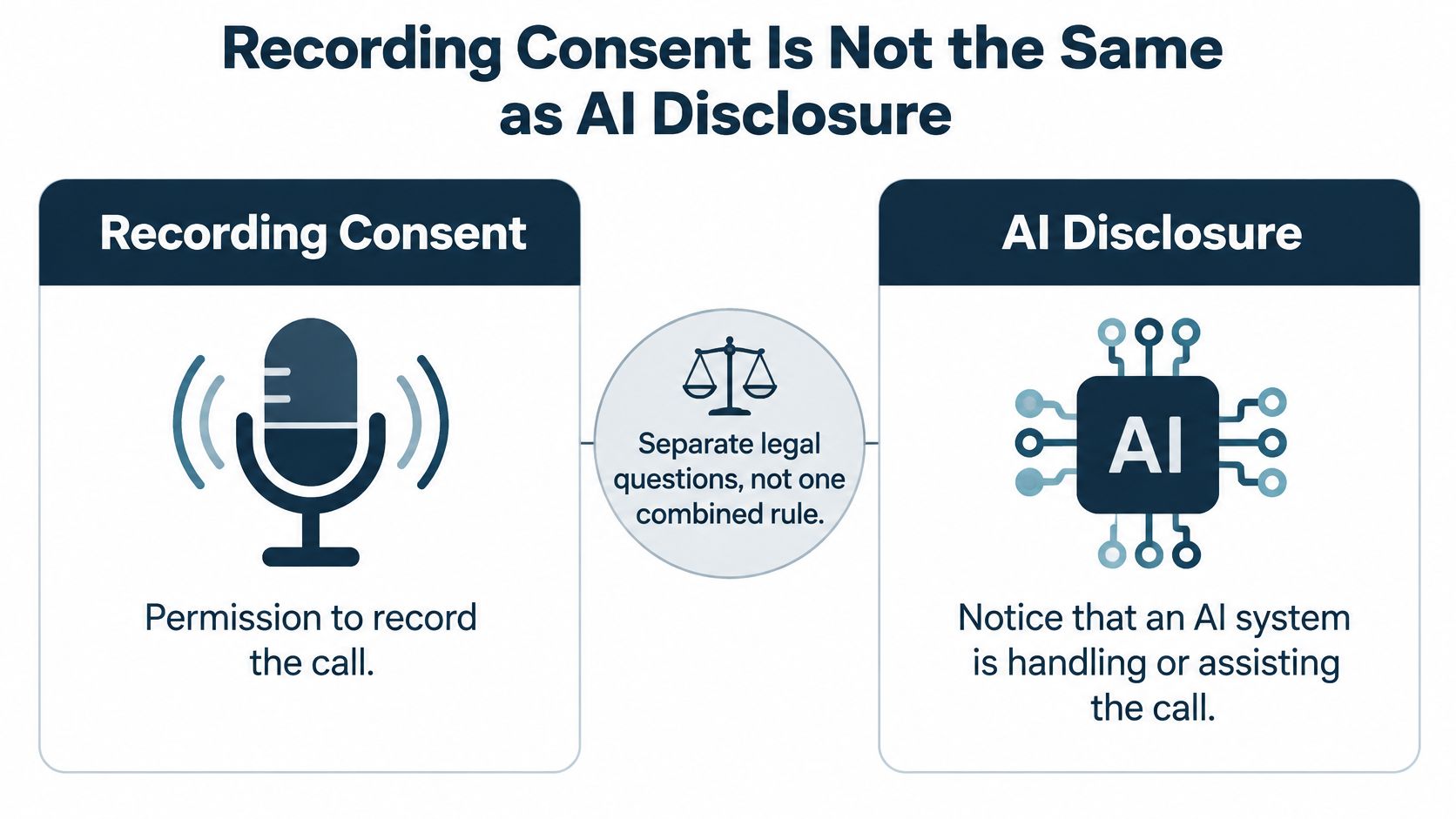
Review each statement on its own
Keep the recording notice and the AI introduction as distinct statements in the call flow. Counsel should determine which ones are needed, when they must be given, and how the caller can respond. Don’t treat a combined script as a shortcut unless counsel has reviewed both duties separately.
Utah law also includes a provision addressing certain disclosure violations when a generative-AI system clearly and conspicuously identifies itself at the outset and continues doing so during the interaction. That provision concerns AI identity disclosures, not whether the call may be recorded or retained. (Utah Code § 13-77-104)
Firms evaluating AI call handling should also distinguish the responsibilities of answering, monitoring, and recording. This comparison of AI answering versus call monitoring can help frame that operational distinction, but it can’t determine which disclosures a firm’s own call flow requires. Ask counsel to check current law before approving language.
What Happens When a Caller Objects to Recording
An inbound call may not come from a prospective client. It could be a witness, an adverse party, a solicitor, or someone who dialed the wrong number. If a firm records every call before screening or conflict checks, it may capture sensitive details from people whose relationship to the firm is unclear. Consent law is only part of the review. Counsel should also consider ethics, confidentiality, conflicts, and whether retaining the information serves a defensible intake purpose.
A caller declines recorded AI intake
The call-handling policy should answer the objection before the system goes live. In Lighthouse’s current product behavior, AI intake requires recording, and recording can’t be turned off while the AI is conducting intake. A caller who doesn’t accept recorded AI intake shouldn’t be encouraged to continue providing information through that recorded process.
Instead, the firm should decide on a human or other contact route and configure it where available. Don’t promise that an attorney will always be available. If a configured transfer reaches an attorney, Lighthouse doesn’t record, transcribe, or retain the ensuing private attorney-caller conversation. The earlier AI intake record remains separate. This describes product behavior, not proof that a particular disclosure meets the law in every jurisdiction.
For the intake team: Make the objection route explicit. A policy can’t rely on an unrecorded AI option if the system doesn’t offer one.
A firm considering different coverage arrangements can review its call-handling service options, then confirm that its selected route matches what staff can provide.
Don’t assume participation means informed agreement
A caller may continue speaking because they didn’t hear the notice, didn’t understand its purpose, or didn’t know recording was a condition of AI intake. For that reason, firms should have counsel assess how consent is obtained and what the system does when the caller objects or appears uncertain. Don’t rely on the existence of an audio file as the only evidence that a caller agreed.
The operational distinction matters too. The recorded AI intake and a later private conversation with an attorney aren’t the same record. A firm should decide who can access the intake record, how it may be shared, and how long it should be retained, while ensuring the workflow doesn’t imply that the human conversation is captured when it isn’t.
A Recording Policy Checklist for Your Firm
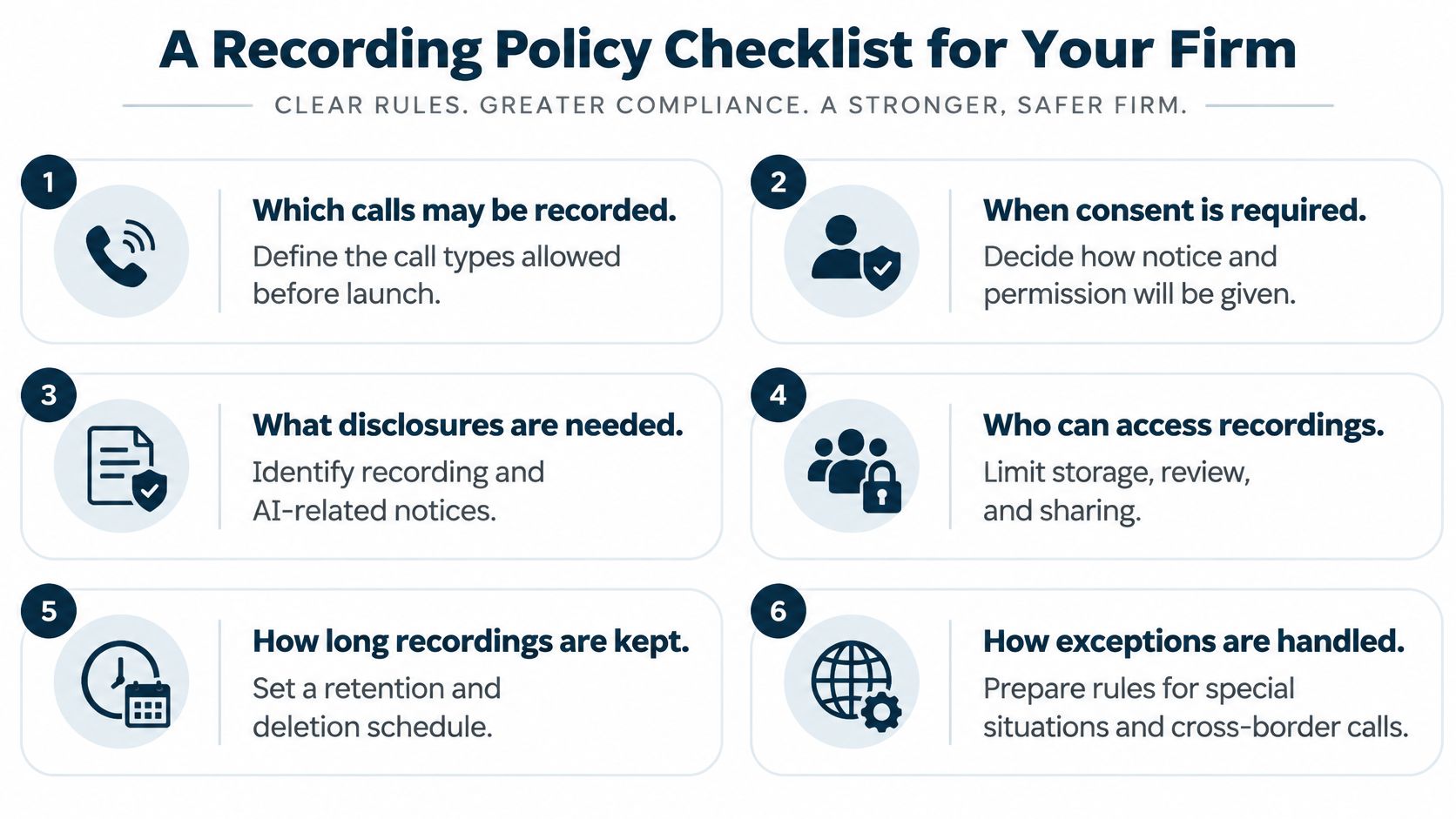
Before launch, ask counsel to approve a written policy and compare it with the configured call flow. The policy should cover the call from its opening notice through any objection, transfer, storage, or later sharing. Use this checklist as a working agenda, not as a substitute for legal review.
-
Which calls may be recorded? Define whether the policy covers AI intake, staff calls, client calls, or other inbound calls. Consider how the firm will handle callers whose relationship to the firm hasn’t been established.
-
What consent is required, and when? Have counsel assess the relevant participants, locations, call type, and applicable federal and state rules. Decide when the notice plays and how the caller’s response is captured.
-
Who approves the exact wording? Identify the responsible legal reviewer. The approved notice should state the relevant purpose and match the actual system behavior. Keep any AI identity disclosure separate for review.
-
What happens when someone objects? Specify the available human or other contact route. Confirm that it works in practice, and don’t imply that recording can be disabled in a system mode that requires it.
-
How are records handled? Distinguish the retained AI intake record from the unrecorded attorney conversation after transfer. Assign responsibility for access, retention, deletion, and sharing of audio and transcripts.
-
How are exceptions checked? Set a process for unusual callers, uncertain locations, and cross-border matters. Confirm current primary legal sources and revisit the policy when laws or the configured call flow change.
A policy on paper isn’t enough. Test the actual workflow: what the caller hears, when recording begins, what happens after an objection, and what is retained after a transfer. Firms setting broader meeting or call procedures may also consult this meeting privacy compliance guidance as a general privacy-planning resource, then have counsel assess the rules that apply to legal intake.
Finally, make sure staff understand the difference between a recording, a transcript, and an intake record, and who is responsible for each. This guide to call transcripts versus intake records can help frame that distinction. Before launch, resolve which calls may be recorded, what disclosures are required, who approves them, and what happens when a caller objects. Then verify that the configured workflow follows the approved policy.
Lighthouse Legal provides customizable AI voice agents for personal injury firms to answer incoming calls, collect intake information, screen inquiries, and connect qualified callers with attorneys or intake staff. If you’re evaluating recorded AI intake, visit Lighthouse Legal to explore the call flow, then take what you learn to counsel for a review of your firm’s notice, consent, and objection policy.