In many personal injury calls, two or three of the four answers the intake team needs are missing, and filling them can take a staff member or attorney 15 to 20 minutes. That gap sits behind every missed ring.
Legal answering sorts the call by firm rules. The service has to identify a new matter, an existing client, or a routine request, then collect the fields the intake team needs. It can provide coverage and route qualified callers to the right person. It cannot decide conflicts, choose representation, or give legal advice.
That makes the receptionist role supervised intake: answer the line, ask the firm’s questions, flag urgency, and hand off when the caller needs a person. The firm sets the criteria and keeps the judgment calls.
Why Injury Callers Leave Before Intake Starts
Before Lighthouse, two or three of the four key answers were often missing from a new personal injury call, and the call could take a staff member or attorney 15 to 20 minutes. That gap shows up long before a case is evaluated. It starts when someone with a fresh injury calls several firms after work and reaches a voicemail instead of a conversation.
The first office answers and listens. The second goes to voicemail. Even if the second firm plans to call back, the caller may already be talking with the office that picked up. Industry surveys suggest that many firms miss prospective-client calls, and fewer answer those calls directly than several years ago. The pattern matters during ordinary client-acquisition hours, not only after the office closes.
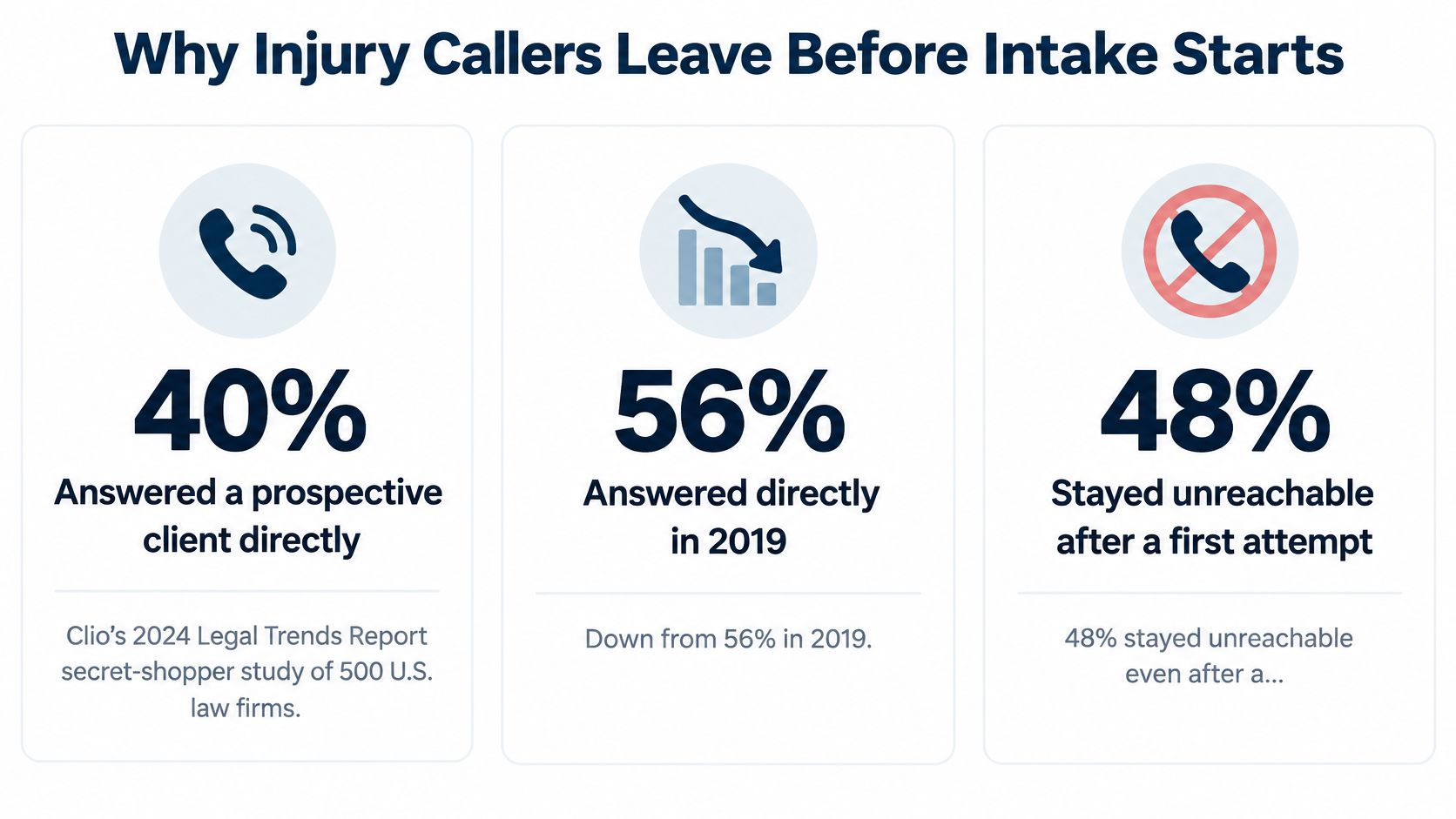
A missed ring and a failed intake aren’t the same thing. Voicemail can preserve a callback number, but it doesn’t establish whether the caller already has a file, whether the injury is new, or which firm-approved facts the intake team needs first. A callback can still be useful. It may arrive after the caller has moved on.
Injury intake works like triage at a clinic front desk. The first job is to sort the call, not diagnose the injury. A legal answering service should recognize an existing client, capture only the firm’s approved intake fields, and follow the firm’s routing rules. It should not decide conflicts, case value, or whether the firm will accept representation.
The practical test: Does the caller reach a person or approved system that can collect the right information and route the call, or do they simply leave a message for later?
For a firm, that test turns on rules rather than a friendly greeting. The service needs to know what counts as a new matter, when to transfer to a person, and which questions are required before the call ends. If those rules are vague, the caller hears a polite message and the firm gets a thin lead.
If your team is also improving phone coverage in another service business, this guide to turning missed calls into booked jobs offers a useful perspective on why a missed inquiry can be hard to recover. For injury intake, the difference is supervised intake: the service follows the firm’s rules for new matters, existing clients, and the line between information and advice.
What Separates Legal Answering from Reception
A new injury call can consume 15 to 20 minutes of a staff member’s or attorney’s time when two or three of the four key answers are missing. The difference between legal answering and general reception is the rulebook behind the answer. General reception is built to take a message. Legal answering is built to sort the call, collect the firm’s approved facts, and hand the caller to the right person without crossing into legal judgment.
A legal answering service works like a triage desk at a hospital. The person at the desk does not diagnose the patient. They ask enough to decide whether this is an emergency, a scheduled visit, or a billing question, and then send the caller down the right path. In a law firm, that triage means separating a new injury inquiry from an existing client and from a routine call about office hours or directions.
| Caller task | General receptionist | Legal answering service |
|---|---|---|
| New, existing, or routine call | Usually one message queue | Separates a new matter, an existing client, and a routine call |
| Intake facts | Name and callback number | Firm-approved fields only, with required, optional, and disabled settings |
| Legal advice | May reassure or speculate | Refuses advice and follows the escalation script |
| Conflicts and parties | Not collected in a set order | Collects limited names and adverse parties first; the firm decides conflicts |
| Routing | Shared inbox for later | Existing cases go to the case team; qualified new matters go to intake |
| Nights and overflow | Voicemail or a closed greeting | Answers continuously with the firm’s greeting and rules |
A name and callback number are not enough for injury intake. A new caller needs a deliberate sequence: confirm whether there is an existing case, ask whether the call is about a new injury, and capture only the fields the firm has marked required or optional. Disabled fields stay unasked. If the firm requires name and phone number but leaves accident date, location, treatment, email, or referral source optional, the service collects what the firm asked for and leaves the rest alone.
A firm-specific script makes the advice boundary concrete. The service can ask for facts, read approved disclosures, and route the call. It cannot estimate claim value, suggest legal strategy, decide conflicts, or promise that the firm will take the case. Those decisions belong to the lawyers, even when the caller asks for a quick opinion.
ABA Formal Opinion 506 supports lawyers training and supervising nonlawyers to collect initial matter information, perform an initial conflict check, determine whether an inquiry concerns an area of law the firm handles, and answer general questions about fees or representation procedures. It also says a prospective client must have an opportunity to communicate with a lawyer about the fee agreement and the scope of representation.
The decisive difference is the firm’s rulebook, training, and supervision. A receptionist with legal experience can still improvise if no one has defined the intake fields, the conflict questions, or the handoff rules. A supervised legal answering setup follows the same script on every call, including after hours. Firms that also use web chat can see how Yappi live chat AI solutions handle automated customer conversations, while the phone standard remains the intake rules above.
How One Inbound Call Gets Covered and Routed
Coverage begins when staff are in court, on another call, or away from the office. The answering setup can use a forwarded number or a new number and follow the firm’s greeting, including when the office is closed at night or on a weekend. Coverage by itself isn’t enough, though. The service needs a defined path for recognizing the caller and deciding where the information goes.
-
Identify the call path. Establish whether the caller is an existing client or case participant, a new injury inquiry, or someone asking a routine question such as office hours or directions. This first distinction prevents an existing case from being treated as a new lead.
-
Collect limited identity information for a possible new matter. Start with the caller’s name, phone number, opposing or adverse parties, and broad matter type. Party names belong early in the process because communications with a prospective client can create later disqualification risks if the firm represents an adverse party. ABA guidance recommends a preliminary conflicts check before detailed information is gathered; it also identifies names of parties and other people connected to the matter as useful screening information. The ABA’s conflicts guidance describes how trained nonlawyers can use firm systems for initial checks, while the firm retains responsibility for its decisions.
-
Collect the firm’s approved intake fields. Client Name and Phone Number stay required fields in Lighthouse intake. Other available fields include Date of Accident, Incident Location, Medical Treatment, Email, and Referral Source. The firm can decide which of those should be required, optional, or disabled for its workflow. For help shaping a firm’s questions, use this personal injury intake questions guide.
-
Apply the firm’s fit rules without accepting or rejecting the case. The service can identify whether an inquiry appears to match the firm’s stated practice criteria, then route or flag it according to the instructions. It doesn’t decide whether the firm should take the matter.
-
Transfer or document the call. Transfer a qualified or high-priority caller according to the firm’s rules, and transfer anyone who asks to speak with a person. Otherwise, record and document the call for the firm’s review. Calls handled by Lighthouse are recorded, transcribed, and graded; the firm receives a recording, transcript, and report for every call, and it owns its call data.
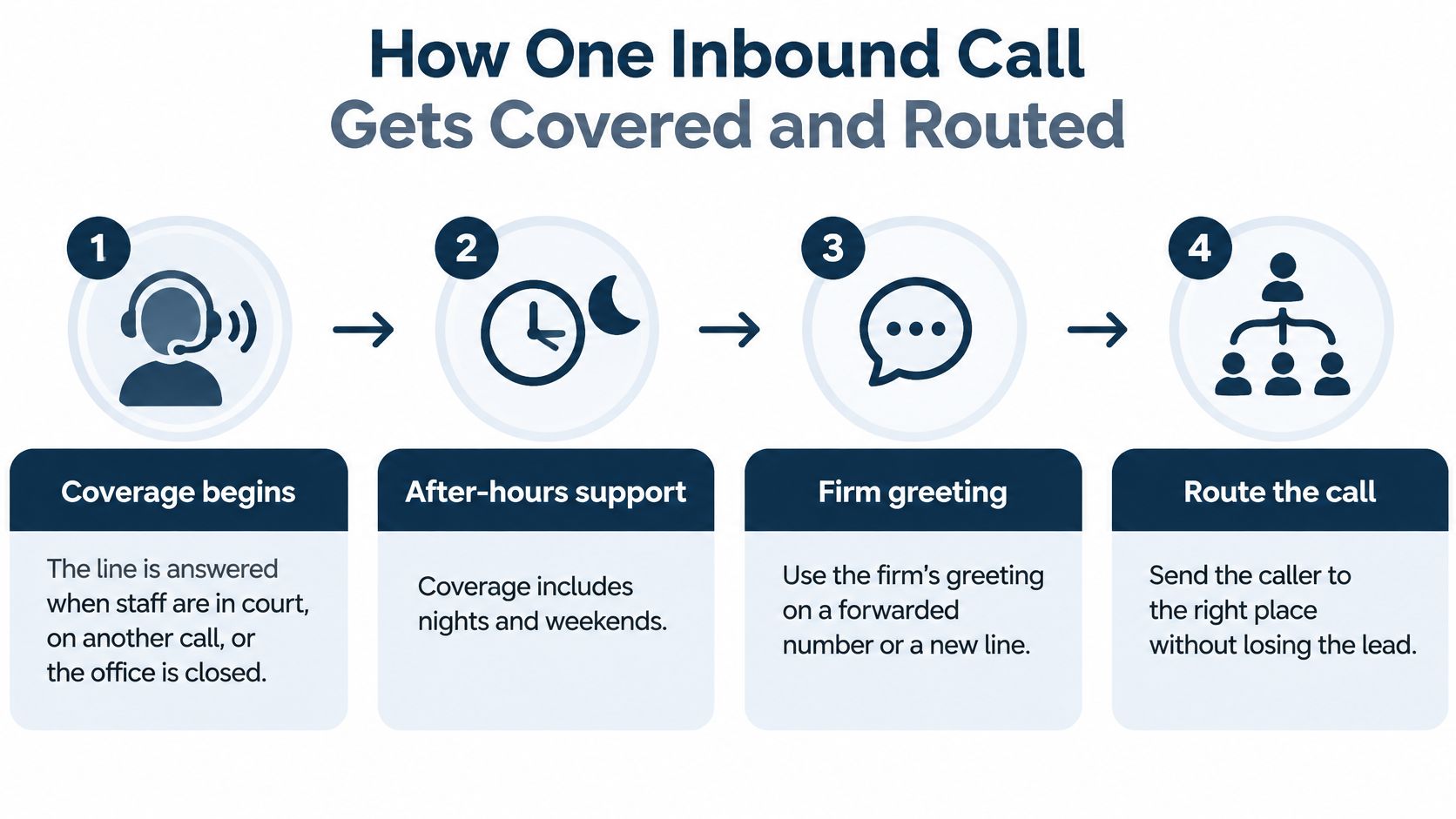
The flow works only if each destination is defined in advance. The firm should tell the service which team handles existing cases, which inquiries qualify for a live transfer, and what to do when information is unclear. A call that doesn’t fit the script should be escalated or documented, not forced into a category. One fictional handoff shows why that first distinction matters.
A Firm Rule That Prevents the Wrong Handoff
Consider a fictional three-lawyer injury firm. At 7:40 p.m., Dana calls about a rear-end crash from the previous month. A generic after-hours script treats every injury call as a new lead, asks for the accident date, treatment, and insurance information, then sends Dana to the new-inquiry queue. The next morning, the intake coordinator calls back and discovers that Dana is already a client with an open file handled by another lawyer in the firm.
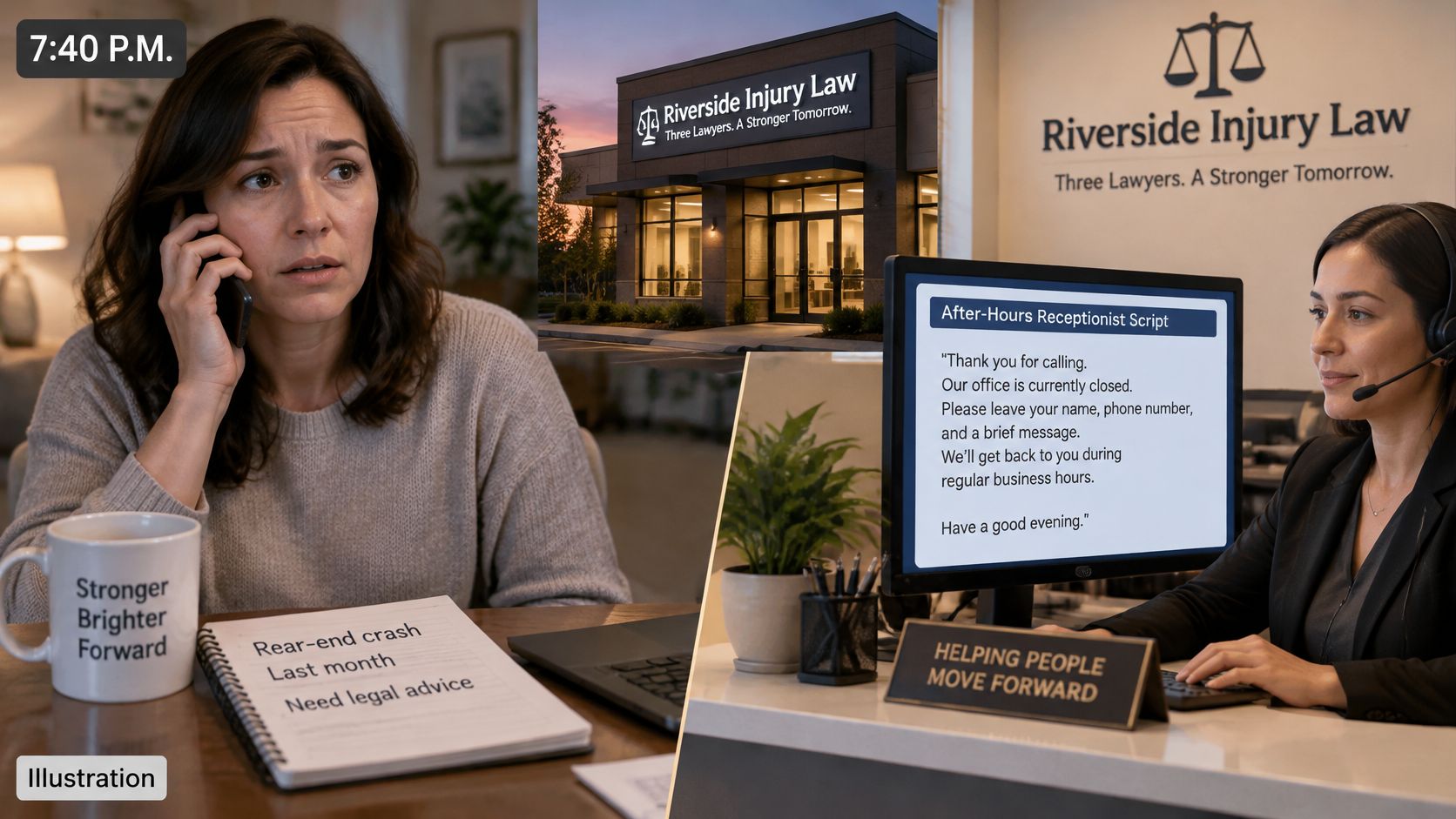
The corrected instruction starts with a simple question: “Do you already have a matter with the firm, or are you calling for the first time?” When Dana gives the existing file name and lawyer’s name, the service stops the new-lead questions. It records that Dana wants a status callback and sends the message to the case team.
The case team gets an existing-client message instead of a new lead. The new-matter queue doesn’t fill with a file the firm already has.
The reverse situation matters too. If a first-time caller can’t identify an existing file, the service keeps the call on the new-matter path rather than sending it to a lawyer’s existing caseload. The firm can define what counts as a useful identifier, such as a case name or the lawyer the caller has been working with, and what to do when the caller isn’t sure.
A transfer can be live or handled as a message, depending on the firm’s coverage rules and the caller’s needs. To assess that choice, review the practical differences between a warm transfer and a cold transfer. Whatever the transfer method, write down the central rule: identify existing clients and case participants before any new-lead screen.
Boundary Questions to Test Before Rollout
Don’t judge a provider’s boundaries by a sales summary. Ask to hear the actual scripts for legal advice, deadlines, conflicts, unclear practice fit, and urgent or stuck calls. Use the answers below as a scorecard.
| Question to test | Acceptable handling | Fail |
|---|---|---|
| Caller asks for legal advice | Refuses strategy, claim value, and any promise of representation; offers a person | Estimates the claim or says the firm will take it |
| Caller asks about a deadline | Flags urgency for a lawyer; doesn’t calculate a limitation period | States a filing date or says there’s still time |
| Possible conflict | Collects names and adverse parties; the firm runs the check | Declares there’s no conflict |
| Unclear practice fit | Marks the matter outside the firm’s work and doesn’t book it as a consultation | Treats every caller as a new lead |
| Urgent or stuck call | Transfers when a person is requested, disclosure fails, dates conflict, language fails, or danger is reported | Keeps the caller inside the automated script |
A caller asking whether a case is valuable needs a different response from someone asking when the office opens. The service may follow an approved script for routine information, but it must not turn a question about claim value, strategy, settlement, or representation into a legal conclusion. For deadlines, it can flag urgency for a lawyer without calculating a limitation period or assuring the caller that time remains.
Conflicts also need a firm-side decision. The service can collect names and potentially adverse parties for screening, but it shouldn’t tell the caller whether a conflict exists. A provider that claims its agent can decide that question is crossing an important boundary.
ABA Model Rule 5.3 requires lawyers to make reasonable efforts to ensure that nonlawyers assisting with client work act consistently with professional obligations. Rule 1.18 creates confidentiality duties toward prospective clients, even when the firm doesn’t take the matter. Guidance on supervising outsourced legal intake emphasizes that intake should be a supervised extension of the firm, with approved scripts, limits on access to transcripts, retention and deletion rules, audit logs, vendor security review, and periodic call sampling.
The product is an intake aid, not a substitute for emergency response or legal judgment. It must not be used for emergencies, time-critical or deadline-sensitive matters, legal analysis, conflict determinations, settlement advice, claim valuation, decisions to accept or reject representation, filing deadlines, legal strategy, or communications with represented parties. The firm remains responsible for its confidentiality controls and representation decisions.
Test the scripts before launch. Call as a new client, an existing client, an out-of-scope caller, and someone asking for legal advice. Then sample the recordings and confirm that each call was handled according to the written rule.
Recording Consent and Required Human Handoffs
Treat recording as a jurisdiction setting, not merely a quality-assurance option. The FCC’s guidance on recording telephone conversations explains that federal law doesn’t broadly regulate private telephone recording, while some state laws restrict recording and may require consent. It warns that recording an intrastate call can violate applicable state law and that unlawful interception may carry criminal sanctions.
A firm covering callers across jurisdictions should identify the caller’s and firm’s jurisdictions where feasible, then use a clear disclosure at the start of the call. The service should capture affirmative consent when required and give the caller a non-recorded option or a prompt human handoff if they refuse. The announcement also needs to be tested across forwarded calls, transfers, voicemail, and callbacks. A disclosure at one point in the call path doesn’t automatically address every later recording point.
Recording and transcription can help staff review whether intake information was captured accurately, but the firm should decide what uses the caller consents to. Recording, transcription, quality monitoring, and storage may involve different data uses. Set rules for secure transmission and storage, who can view transcripts, how long records are retained, and how deletion requests are handled.
Use the firm’s call-recording compliance guide as a starting point for writing the workflow, then check the applicable rules with the firm’s own counsel.
Automation should stop when it can’t communicate reliably or safely. Transfer to a person when the caller requests one, can’t understand the disclosure, needs an interpreter, has a hearing, speech, or cognitive barrier, reports imminent danger, or gives contradictory dates. Keep the limited information already collected and note why the script stopped. Don’t turn a difficult conversation into a longer automated interview just to complete every field.
A transcript can look complete while leaving out confusion, distress, or a communication barrier. Supervisors should sample calls under the firm’s access and retention rules, including calls where the service handed the conversation to a person.
Who Should Add Inbound Injury Coverage
Inbound injury coverage fits solo injury lawyers, small plaintiff firms, and intake managers who need help answering calls at night, on weekends, or during overflow. It’s useful when the current problem is unanswered injury inquiries, staff time spent screening unsuitable calls, or qualified callers waiting until morning. It’s not a fit for a firm primarily seeking outbound calling, legal advice about deadlines or case value, or general back-office support for files and billing.
Before forwarding a number, write three rules: how the service recognizes an existing client, which intake fields are required, and which calls must transfer immediately. Those decisions give the service a working process instead of a broad instruction to “screen leads.” Then compare coverage that ends at closing with continuous answering using the same firm rules.
A small trial can show whether the workflow holds up without replacing the phone system:
- Call a demo as a prospective injury client. Ask what the firm handles and listen for whether the response stays within the approved script.
- Test contrasting caller types. Run a new-client call, an existing-client call, an out-of-scope call, and a request for legal advice.
- Forward two evenings. Compare the recordings, transcripts, and transfers with the firm’s usual process.
- Keep the provider only if the rules work. Confirm that each call lands where the written instruction says before expanding coverage hours.
For records that need a signature after intake, the firm can separately assess tools for collecting signed documents, such as eSignature solutions for lawyers. That’s a different workflow from answering an inbound inquiry, so it shouldn’t be treated as a substitute for phone screening or routing.
Lighthouse builds AI answering for personal injury law firms, with customizable voice agents that follow the firm’s criteria, never give legal advice, and transfer to a person when asked. The firm can try a free trial or call the demo agent at +1 (681) 376-0380 as a prospective injury client. Monthly pricing is volume-based and discussed on a demo rather than published here.
Lighthouse Legal provides customizable AI voice agents for personal injury firms, answering inbound calls, collecting intake information, and connecting qualified callers with attorneys or intake staff. Visit Lighthouse Legal to test whether its supervised phone intake fits your firm’s coverage rules and caller handoffs.