An answering service is a business function in which an operator or automated system takes a company’s calls, records messages, or routes callers under a script when the company cannot answer. What separates a good one from a message pad is speed: a 2025 study of 1,333 U.S. law firms found a 13-minute median response time to online inquiries, only 25% responded within five minutes, and 26% failed to respond within a week.
Those numbers come from Hennessey’s 2025 lead form response time study, and they describe a pattern most attorneys recognize from their own inbox. A prospective client calls at 9:12 p.m., hears a recorded greeting, and leaves eleven seconds of audio that says nothing about the crash, the injuries, or whether the matter conflicts out before anyone spends a callback on it.
An answering service sits between that caller and your calendar. What it does, what it doesn’t do, and which decisions stay with you are the three things worth understanding before you sign anything.
What an Answering Service Does for a Business
Picture a two-attorney firm at 5:40 p.m. The receptionist has left, the phones still ring, and every call that rolls to a recorded greeting is a decision the firm didn’t make. An answering service is the receptionist who stays on duty after the lobby lights go off.
It’s a business communications function in which calls to an organization are received and managed by an operator or automated system on the organization’s behalf, as Morgan Systems’ account of phone customer service history describes. The core activities are unglamorous: greeting callers, identifying their purpose, recording messages, providing basic information, routing calls, and escalating urgent matters.
The model is older than most of the software sold around it. Small commercial answering bureaus appeared in the 1920s, initially serving professionals such as doctors, and the tools have changed constantly since. The purpose hasn’t. Calls get acknowledged, documented, and directed even when the person the caller wanted isn’t available.
For an attorney, the practical definition is shorter. The service answers when the firm needs coverage, captures a message or routes the caller according to a script, and, in some setups, screens new inquiries against criteria the firm provides.
Quick self-check before you shop: Do you need coverage, message-taking, or screening of new inquiries? Those are three different purchases, and a provider that’s excellent at one can be mediocre at the others.
Answering Service, Voicemail and In-House Staff Compared
A new injury caller dials your firm at nine on a Tuesday night. Which of three setups answers that call decides what happens next.
| Feature | Voicemail | In-house staff | Answering service |
|---|---|---|---|
| Live coverage hours | None, messages only | Office hours only | Often 24/7 through AI or after-hours plans |
| Live answer | No | Yes, during staffed hours | Yes, through a person or an AI agent |
| Follow-up questions asked | No | Yes, if trained | Yes, when scripted by the firm |
| Structured intake record | No | Manual notes, quality depends on who answered | Yes, when the firm sets the fields |
| Transfer to a person | No | Immediate when staff are present | Configured transfer to an on-call person, with a connect rate you should test |
| Recording and transcript | Audio only | Recording and transcript if the phone system supports them | Often recording, transcript and report |
| Legal advice | Not provided | Attorney decision | Not provided, attorney decides |
| Cost pattern | Low fixed fee | Salary and benefits | Flat monthly fee tied to call volume |
Only a few rows decide outcomes for a law firm: live coverage hours, whether someone answers live, whether anyone asks a follow-up question, whether the call produces a structured record, and whether the caller can reach a person. The remaining rows describe how each option is packaged and priced.
The gaps differ by option. Voicemail works like a locked drop box: it stores audio and leaves the caller waiting, often until the next business day, with no way to tell a fender-bender from a serious injury. In-house staff handle calls well during office hours, while nights, weekends, and the stretch when everyone is already on another line go uncovered.
An answering service exists for exactly that gap. A configured service, human or AI, can answer around the clock, ask the firm’s screening questions, and transfer the callers who qualify. Lighthouse’s AI receptionist is one implementation: it answers forwarded calls 24/7 with the firm’s greeting, screens against the firm’s intake criteria, and connects qualified callers to the team.
One row runs the same across all three columns. Legal advice stays with the attorney under every option, because the service’s job is to capture and route the call while the firm keeps the decision.
Speed explains why the live-answer and transfer rows carry as much weight as coverage hours. The ABA’s Law Practice Magazine cites the MIT Lead Response Management Study, which found the odds of contacting a lead fell by 100 times when response came after 30 minutes rather than within 5 minutes, and the odds of qualifying the lead fell by 21 times.
The test that matters: Pull your last ten missed or after-hours calls and ask which row of that table would have changed each outcome. If the answer is usually “structured record,” the purchase is intake: a system that captures the same fields on every call.
Service Models From Live Bureaus to AI Intake
| Model | Who answers | Typical coverage | Best fit |
|---|---|---|---|
| Live human bureau | Trained operators, often shared across many clients | After hours, weekends and overflow | Firms that want a person on every call |
| AI intake agent | Configured AI voice agent using the firm’s questions | 24/7 on forwarded or after-hours calls | Solo and small firms needing structured intake |
| Hybrid | Staff by day, service or AI by night | Daytime staff plus after-hours cover | Multi-attorney firms with an intake team |
| Overflow only | Service answers when lines are busy or unanswered | Peak volume and missed calls | Firms with staff who want a backup |
A live human bureau suits the firm that wants a warm voice and doesn’t mind that the operator also serves a dentist, a plumber, and a property manager that night. Trained operators follow your script, but the person answering has usually read it for the first time that week.
An AI intake agent takes the firm’s own questions and applies them consistently at 2 a.m. and at 2 p.m. Our AI receptionist answers forwarded calls with the firm’s greeting, so the caller hears your name, not a vendor’s.
A hybrid keeps your staff on daytime calls and hands evenings and weekends to the service. That’s the shape most multi-attorney firms end up with: the front desk owns the familiar callers, the service owns the unknown ones after five.
Overflow-only is the lightest touch. The service catches what staff can’t reach, which means you’re paying for backup rather than coverage, and you get no after-hours intake at all.
One setup detail shapes results more than the model does. When another number rings at the same moment as the service’s number, a person can pick up first and the agent never joins the call. Ring order decides who answers, so configure it deliberately rather than leaving the default.
The choice rule: Match the model to your monthly call volume, the hours you actually need covered, and whether the call requires structured follow-up or just a warm human answer. A firm taking four after-hours calls a week is buying something different from a firm taking forty.
Intake Fields to Define and What Voicemail Misses
An intake field list works like a paper intake sheet that never changes: the same boxes, in the same order, on every call. Define the boxes before the service answers anything, because what you define is what you get back.
| Field | Required or optional | Why it matters |
|---|---|---|
| Client name | Required | Identifies the caller for callback |
| Phone number | Required | Makes callback and call tracing possible |
| Date of accident | Optional | Flags time-sensitive matters |
| Incident location | Optional | Checks that the firm handles that jurisdiction |
| Medical treatment | Optional | Helps set priority and case merit review |
| Adverse party and insurance | Optional | Starts the conflicts check |
| Email address | Optional | Sends follow-up material |
| Referral source | Optional | Tracks where leads come from |
| Disqualifying conditions | Set by firm | Ends the call early for matters the firm does not take |
The work the service does is conversion: unstructured caller speech becomes standardized case data, with date, location, injuries, adverse parties, and insurance landing in the same columns every time. The ABA Journal’s reporting on how firms handle calls from potential clients describes the pattern on the other side of that exchange: prospective clients hit voicemail or no answer at all, hang up, and move down their list.
The chain runs in one direction. Continuous availability means fewer callers hit voicemail. The same questions in the same order mean two callers can be compared fairly. Immediate escalation shrinks the gap between inquiry and a person who can act on it from a day to minutes. That last link is what turns a service into an intake and speed-to-human system.
Voicemail skips the whole chain. It stores whatever the caller felt like saying, in whatever order, and leaves your staff to reconstruct the facts later, usually while the caller is already talking to another firm.
A voicemail preserves what the caller chose to say. A configured intake workflow captures what the firm needs to decide.
Length has a cost. Every extra question is a chance to lose the caller, so keep the required set to what a callback and a screening decision demand and let the rest stay optional. If you want a fuller question bank to pull from, these personal injury intake questions cover the ground most firms need.
Before go-live, decide five things in writing:
- Mandatory fields: what a callback and a screening decision cannot proceed without.
- Disqualifying conditions: the answers that end the call early.
- Priority tiers: which callers get transferred now and which get a next-morning callback.
- Transfer destinations: the on-call person for each call type and time of day.
- Human takeover rule: when the agent must hand the call to a person.
Then write your own field list and mark each row required, optional, or disabled. If a field changes neither the routing decision nor the callback, it belongs in the optional column or out of the script.
How One After-Hours Call Moves From Answer to Review
A driver is sideswiped on the way home at 9 p.m. and calls the firm’s intake line. The office is dark. Before an answering service, the call died there: Garrick McFadden ran his practice answering his own intake line, and when he could not pick up, the call went unanswered. Here is what happens now, in order.
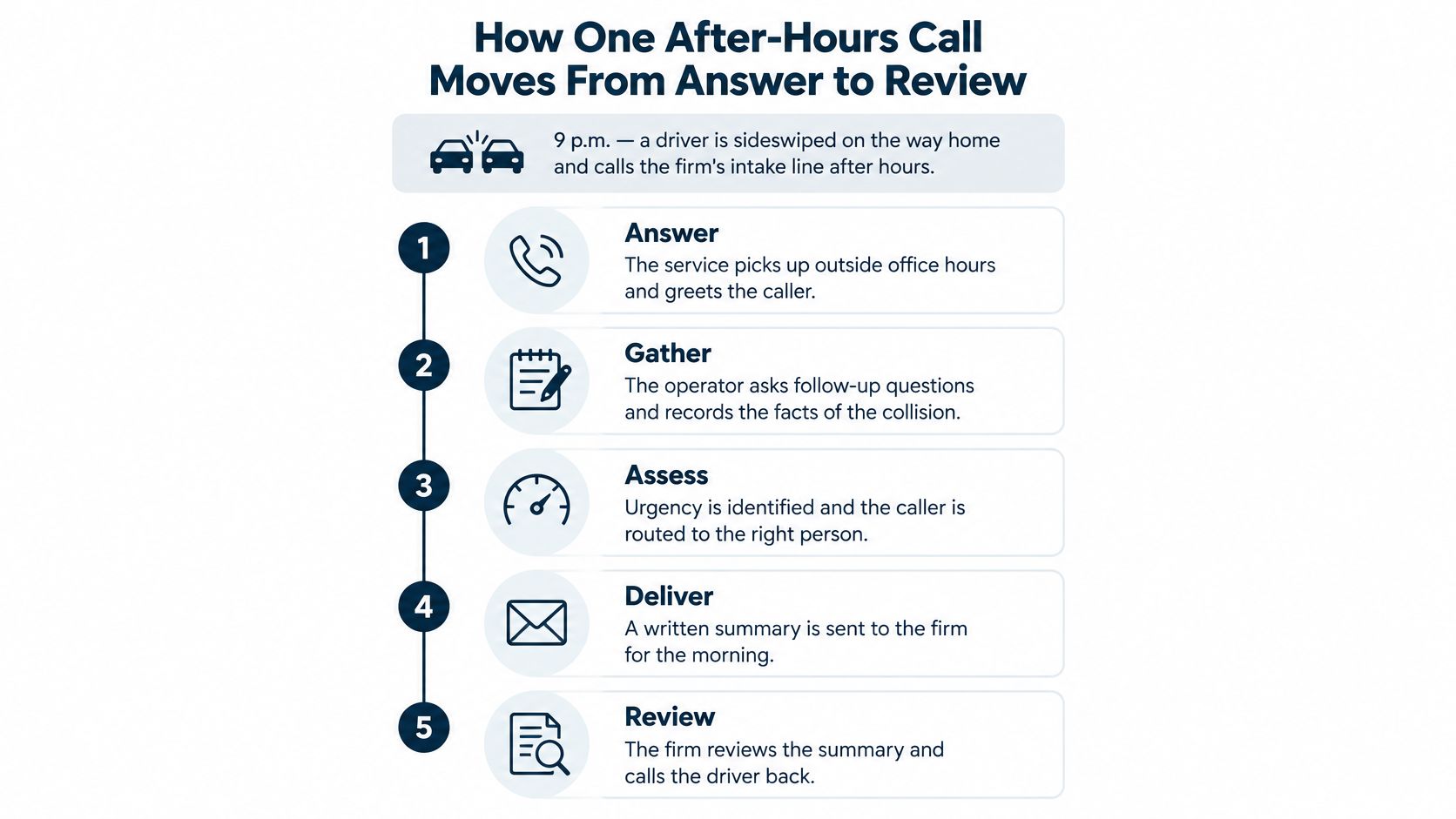
- The service answers immediately with the firm’s greeting and confirms the caller reached the right office. No hold music, no menu tree.
- It identifies the purpose. Crash inquiry, existing client, vendor, or someone checking office hours. The path splits here.
- It collects the required fields. Client name and phone number stay mandatory, because a dropped call with no callback number is a lost call.
- It asks the basic facts in order. Date of accident, incident location, medical treatment, email, referral source. Short questions, one at a time.
- It applies the firm’s rules. Priority tiers and disqualifying conditions decide whether this caller is high priority or a next-morning callback.
- It attempts the configured transfer to the on-call attorney. If nobody picks up, it records the call and tells the caller what happens next and when.
- It sends the recording, transcript, and summary to the firm for review.
Every step on that list is intake and routing: capture, screen, connect, document. The manual version used to cost a staff member or attorney 15 to 20 minutes per new personal injury call, and two or three of the four key answers were often still missing. The service compresses that work into the call itself, and the firm owns the call data it produces.
The judgment calls stay with the firm. Your attorneys still run conflicts analysis before accepting anything. ABA Formal Opinion 492 and Model Rule 1.18(c) bar a lawyer from representing a client whose interests are materially adverse to a prospective client in the same or a substantially related matter when information received could be significantly harmful, and the restriction can extend across the firm. The service can flag a priority caller in minutes. Whether the firm may act on that call is a legal decision, and a fast answer never substitutes for it.
Daytime and evening calls often take different paths. At Chandler Conway’s firm, staff still take daytime calls while the service covers evenings and weekends and picks up when the front desk cannot answer, so the same caller can reach a person at 10 a.m. and an agent at 10 p.m.
The difference between a warm handoff and a cold one is whether the receiving attorney hears the facts before the caller repeats them. The mechanics are covered in this breakdown of warm transfer vs cold transfer.
The script also needs a destination for matters outside your practice. A crash that ends in an arrest has to go somewhere. If your referral list includes a criminal defense practice, the agent can point a caller who needs to request help with DUI charges toward a real destination instead of a generic message.
Coverage is configurable, not fixed. The service can answer all new-case calls, after hours only, or only when staff do not pick up, depending on what your phone provider supports. Because every call is recorded, transcribed, and graded, after a few weeks you can review which answers staff use and cut the questions nobody reads.
Why Callers Accept an AI Voice Under Clear Conditions
Most attorneys assume callers want a human voice and will hang up on anything else. The survey record is more interesting than that. In a 2025 survey of more than 2,000 consumers and over 500 small and medium-sized businesses, 29% of consumers had already spoken with AI by phone, while 87% said they would accept voice AI under specified conditions, according to Anny’s survey analysis on AI phone acceptance.
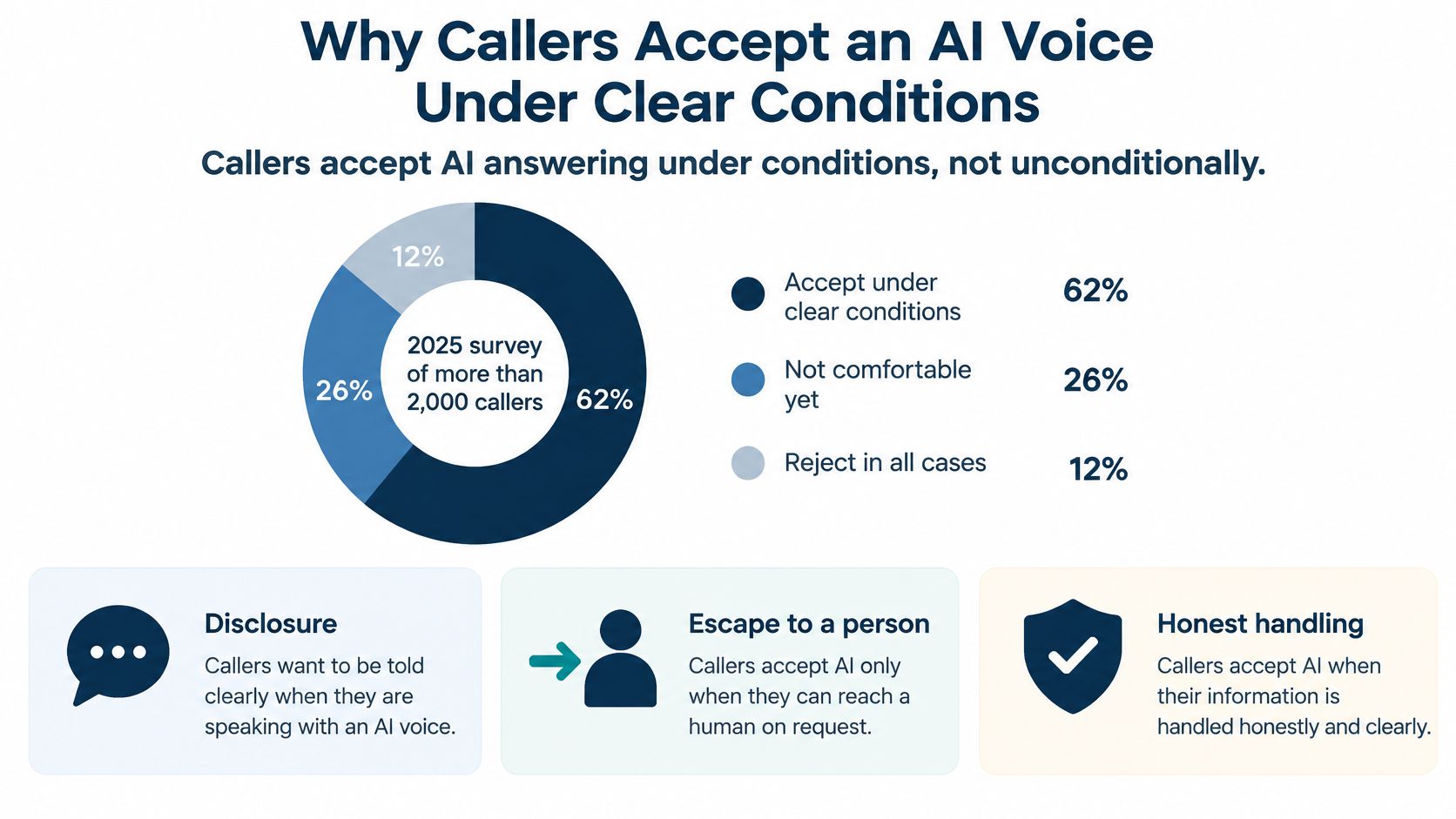
The conditions tell you what to build. The strongest one was the ability to transfer to a human at any time, selected by 52% of respondents. Then 41% wanted clear disclosure that they were speaking with AI, and 32% emphasized strict privacy and transparency.
That inverts the usual design instinct. An AI answering service doesn’t need to imitate a person to succeed. Clear identification, an easy handoff, concise questions, and a narrowly defined role may earn more trust than a human-sounding performance that falls apart on the second follow-up.
What this sounds like in practice: The caller asks for a person, the agent transfers without arguing. The caller asks for legal advice, the agent says it can’t give advice and that the firm will follow up. Two sentences, no friction.
For personal injury intake, the boundary should be explicit: the agent gathers information and routes inquiries, and never evaluates the claim. Our AI voice agent follows the firm’s criteria, doesn’t give legal advice, and transfers to a person when asked.
Five questions separate a trustworthy setup from a risky one. Ask them in writing:
- Consent and disclosure: Does the agent say what it is within the first few seconds?
- Human transfer: Is a person reachable on request at any hour, and what’s the connect rate?
- Accessibility: Can a caller with a language or hearing need reach help without repeating the whole story?
- Recording governance: Who can listen to the audio, and how long is it kept?
- Data ownership: Does the firm, not the vendor, control the resulting intake data?
Firms already thinking about how AI answer engines pick firms will recognize the pattern. In both cases, clarity about who is speaking and what happens next beats clever mimicry.
What Stays With the Firm After the Service Answers
Here’s the division that matters. The service can ask follow-up questions, record facts, identify urgency, and route a caller under your rules. Review, callback, legal advice, conflicts checks, required notices, and the decision to represent stay with you. Our product is built to assist with the administrative, operational, intake, and scripted communication workflows a firm designates and supervises.
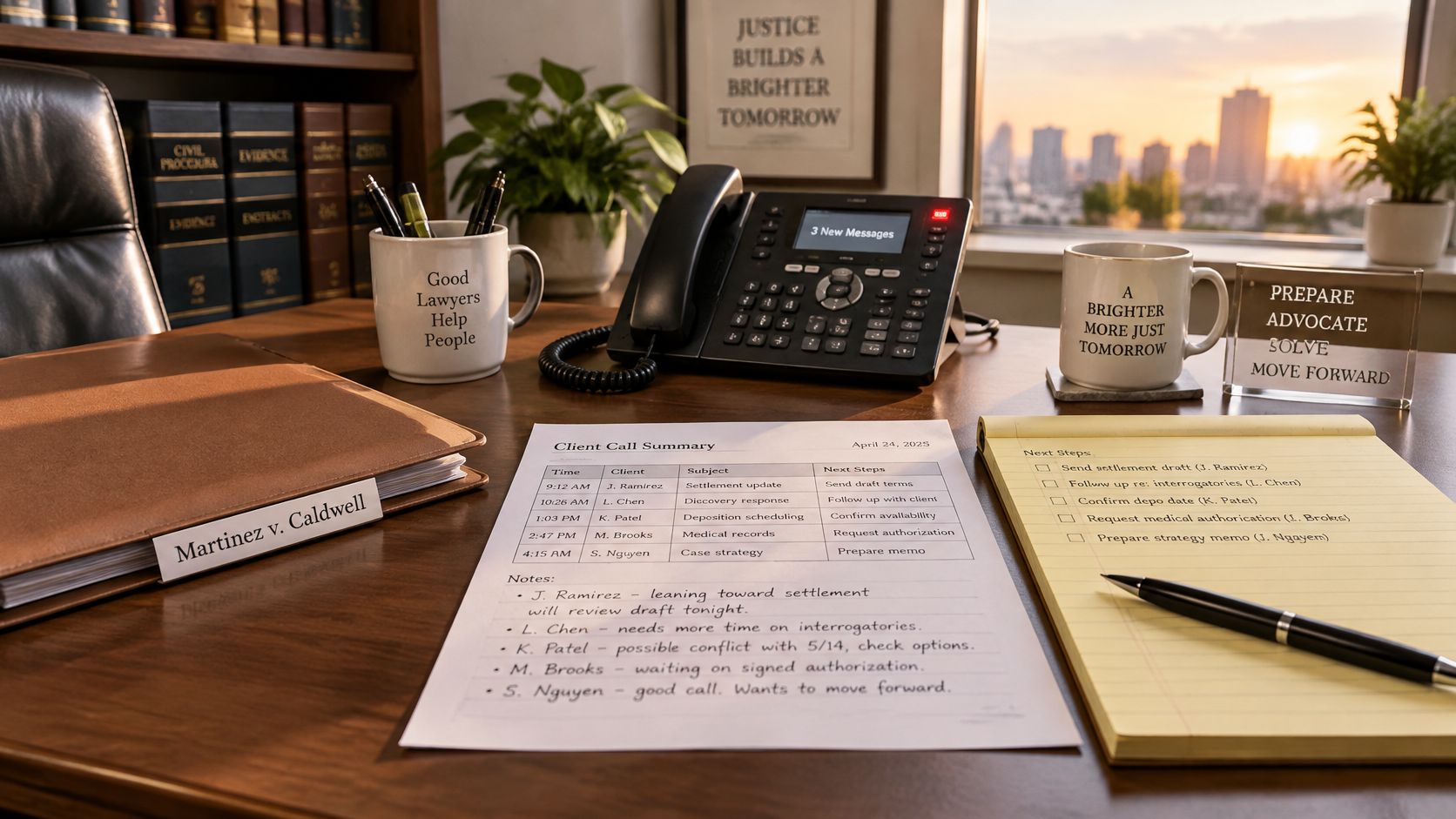
The communication duty is the clearest example. ABA Model Rule 1.4 requires a lawyer to promptly inform a client about decisions or circumstances requiring informed consent, reasonably consult about how the client’s objectives will be pursued, keep the client reasonably informed about status, promptly comply with reasonable information requests, and explain matters as needed for informed decisions. An intake summary doesn’t discharge any of that.
Confidentiality travels the same road. ABA Model Rule 1.18(b) provides that even when no attorney-client relationship results, a lawyer who learns information from a prospective client must not use or reveal it except as the former-client rules permit. A scripted or automated answer doesn’t remove those duties because no lawyer personally picked up.
A transcript is an intake record for evaluation. It’s not a legal conclusion, and it’s not a promise that the firm has accepted the case.
Adopt these five controls before the first call comes in. Set a review deadline for every new intake (same day for anything flagged urgent). Name one owner for callbacks. Keep a log of declined matters with the reason. Decide who may read transcripts. Confirm which notices the firm must send and who sends them. Each item depends on jurisdiction and firm policy, so run your version past ethics counsel.
One more practical thread: the people who read the summaries are usually legal intake professionals rather than attorneys, so the report has to be written for them. If a field doesn’t help that reader decide who to call first, it’s noise.
Confirm Your Intake Rules Before You Choose a Service
You’ve set the fields. Now test before you commit.
- Bring your field list to the demo. Confirm the service can collect every required field and apply your disqualifying conditions, not just a generic script. Prospective customers can bring their current intake questions and try example calls with made-up case details, then review the transcript and report that comes back.
- Run example calls with invented facts. A fictional rear-ender at 11 p.m. with a treatment gap tests more than a friendly greeting does. Check that each field landed in the right place and that the summary reads the way your staff would write it.
- Measure the trial. Track the share of calls answered live, how often a configured transfer reached a person, the share of intakes completed, and how long a qualified caller waited for a human. Hold those results against the five-minute and thirty-minute marks.
- Get written answers to the five governance questions. Consent, transfer availability, accessibility, recording policy, and data ownership should be in the contract, not in a sales conversation.
If you want to hear the thing before a meeting, our demo agent can be called at +1 (681) 376-0380 and treated like a personal injury client with a made-up case.
Pick the model from the table that matches your hours, your volume, and your intake needs, then run it for a fixed two-week window before expanding. Two weeks of transcripts teaches you more than two months of brochures.
Lighthouse Legal builds AI voice agents for personal injury firms that answer every call, ask your own intake questions, and connect qualified callers to your team. You can bring your current screening questions to a demo and hear exactly how they sound on a call. Visit Lighthouse Legal to see how the intake workflow fits the way your firm already evaluates new matters.