A prospective client calls your office at 6:40 on a Friday. She was rear-ended two hours ago, her neck is stiffening, and she found your firm on her phone in a parking lot. Your receptionist left at five, the line rings four times, and then she hears fifteen seconds of recorded voice. What that voice says decides whether she leaves her details or taps the next number on the list.
That is the entire job of an out of office phone greeting. Not to sound warm, not to prove the firm exists, but to hold a person who is injured and one tap away from a competitor long enough to capture a callback number and a reason.
Most firms treat the greeting as a formality, recorded once during setup and never revisited. The result is a message that announces closure and offers nothing. The eight scenarios below cover the absences a personal injury practice faces: vacation, after-hours, emergencies, overflow, holidays, disclosure requirements, automated intake, and the plain everyday message. Each comes with a script you can adapt and the trade-offs worth knowing before you record.
1. Standard Away Greeting with Return Date and Alternate Contact
Every other greeting on this list is a variation on this one. It names the firm, says who is unavailable, gives a return date, and hands the caller a second route.
A caller dials a solo attorney’s direct line and hears a message recorded three weeks ago announcing a holiday closure. One stale detail does more damage than a plain message would, because it tells the caller nobody is maintaining the line.
The stakes are easy to underestimate. In a 2025 survey of 1,000 U.S. consumers, 78% said they had abandoned a business because a call went unanswered, and 82% said they would call a competitor in that situation, per RedialBPO’s review of missed-call and after-hours behavior. The sample covers general consumers rather than legal clients, so treat those figures as a floor for how fast patience runs out.
Script to adapt: “Thank you for calling Smith & Associates. I am out of the office until Monday, March 3. For urgent matters, please call our main line at 555-0142. Otherwise, leave your name, number, and a short description of your situation, and I will return your call when I am back.”
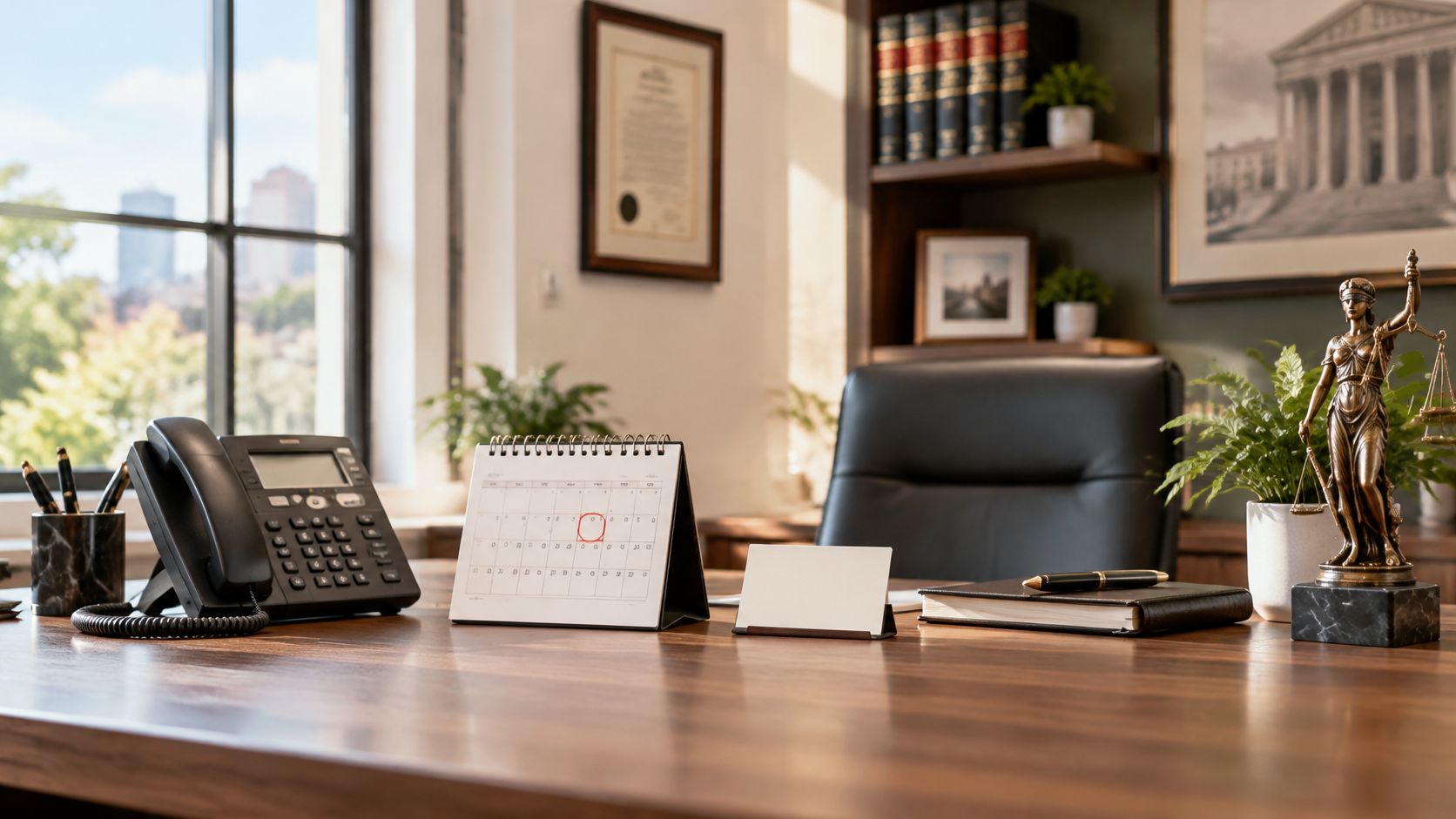
A calendar with a circled return date is the whole mechanism behind this greeting. Get the date right and the rest follows.
- Update the date, then remove it: A return date that has already passed reads as negligence. Set a reminder for the morning the attorney returns and record a fresh message that day.
- Always give a second route: A staff extension, an intake line, or an email address. A caller with no alternative has no reason to stay on the line.
- Keep it under 20 seconds: Long greetings raise the odds of a hang-up before the beep, and the beep is where the useful information starts.
2. After-Hours Intake Greeting with Options
The phone rings at 9:15 p.m. and nobody picks up. A message that only announces closure asks the caller to do the one thing few callers will do.
The evidence on that is blunt. An analysis of more than 18 million missed calls found that only 15% of callers left a voicemail, with the after-hours rate lower still at 14%, against 16% during business hours, according to Quo’s breakdown of why callers don’t leave messages. Fourteen of every hundred people who reach your line at night will tell you what happened. The rest hang up.
The setup is unglamorous: a handset, a script taped to the desk, and a log someone checks before coffee.
Script to adapt: “Thank you for calling. Our office is currently closed. Our hours are Monday through Friday, 9 a.m. to 5 p.m. If you were recently injured and need immediate medical help, hang up and dial 911. To leave details about your situation, press 1 now. To hear these hours again, press 2.”
Two or three options, the most common one first, then a short intake prompt. Name, callback number, date of incident, and one line about what happened. That’s enough to triage the morning.
Four rules that keep the menu usable
- Log messages before anything else: After-hours calls sit overnight, so make entering them in the intake system the first task of the business day.
- Don’t interview on voicemail: A full case history left on a recorded line is slow, error-prone, and puts sensitive detail where it doesn’t belong.
- Make the promised callback real: A menu that collects details nobody calls back is a longer way of ignoring someone.
- Review the log weekly: Patterns show up fast, a run of Sunday-night calls or a cluster after a local crash. Staffing follows the pattern.
Building this for a small team is its own project, and after-hours intake for solo law firms walks through the sequence from greeting to morning callback. The front desk shouldn’t be the only thing standing between an injured caller and your calendar.
3. Emergency-Routing Greeting for Urgent Matters
Urgency is what separates a personal injury caller from someone asking about a lease. A greeting that treats a Friday night collision the same as a request for a demand letter wastes the only minute that matters.
Put the emergency instruction first, before the firm name or immediately after it. If someone is bleeding, in danger, or being threatened, the phone is the wrong tool and the greeting should say so within five seconds.
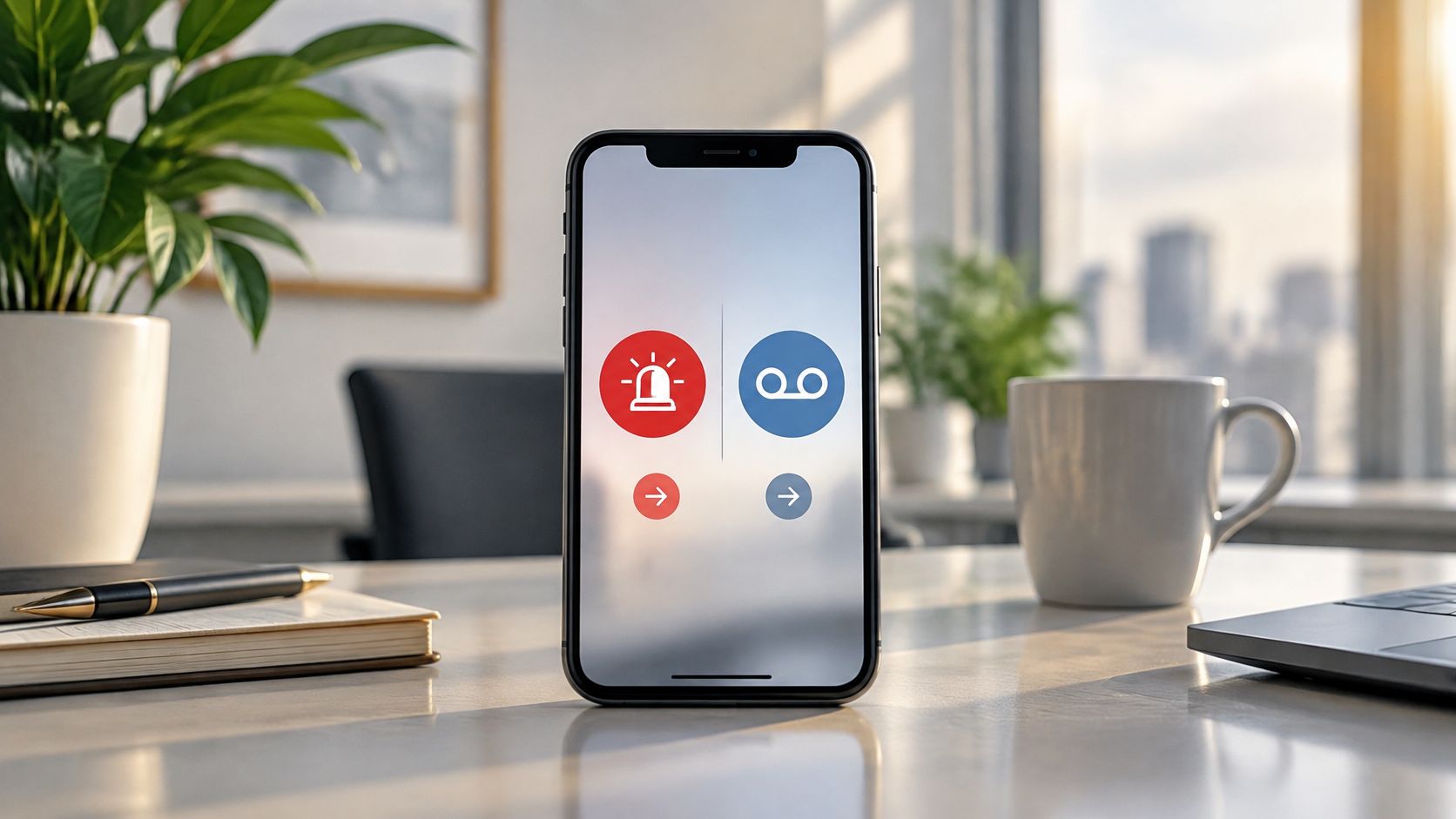
“If you are experiencing a medical emergency, please hang up and call 911. If you have a court deadline or hearing within the next 48 hours, press 0 to reach the on-call attorney. For all other inquiries, please leave a message and we will return your call the next business day.”
Every option in the greeting should map to a button that works. Test it from a cell phone, not from the desk phone that shares the same system.
An on-call promise is only as good as the person behind it. Nextiva’s customer service response-time benchmarks cite the conventional contact-center 80/20 service level, meaning 80% of calls answered within 20 seconds, and report that 54% of callers hang up after eight minutes on hold. Route a panicked caller to an attorney who picks up in nine minutes and you’ve cleared the queue and lost the case.
Make the routing real
- Write down what counts as urgent: A hearing inside 48 hours, a client in custody, a hospitalization, a call from a jail. Anything outside that list goes to voicemail.
- Name the on-call person in a shared calendar: Rotating responsibility recorded nowhere becomes nobody’s job by the second weekend.
- Test the press-0 path monthly: A phone system upgrade can break a transfer without notice, and nobody notices until a caller complains.
A second route is worth having: call routing software can send qualifying calls to a mobile number while holding everything else until morning.
Matching the caller to the right counsel matters outside your practice area too. When someone needs a different specialty, point them to a resource such as this guide to finding an experienced Florida divorce attorney rather than collecting a message you’ll never act on.
4. Overflow Coverage Greeting for Busy Teams
Overflow isn’t an emergency. It’s 11:20 on a Tuesday, three lines are lit, and the intake coordinator is on hold with a hospital billing department for an existing client. The caller knows none of that and shouldn’t have to.
A firm with two attorneys and one coordinator doesn’t need a night message at 11 a.m. It needs a greeting that says the team is occupied and sets a short, honest callback window.
The numbers support treating this as a capacity problem rather than an etiquette one. A 2025 benchmark built on 1.1 million de-identified conversations reported a 28% missed-call rate for legal businesses, against 32% for health care, 14% for home services, and 9% for real estate, per Seod’s analysis of after-hours call handling. The same source cites a Harvard Business Review audit of 2,241 U.S. companies in which 23% never responded to an inbound lead and 24% took more than a day.
Script to adapt: “Thank you for calling Rivera Law Group. Our team is currently assisting other clients. Please leave your name, phone number, and a brief description of your matter, and an intake coordinator will return your call within two business hours.”
Two hours is the number that matters. Set a window your team can hit on its worst day, not its best.
Run it as a schedule, not a recording
- Name the required fields: Name, number, date of incident, whether treatment has been received. Four items, thirty seconds.
- Assign it to time blocks: Overflow message from 11 to 3 on Mondays, standard away greeting otherwise. Most business phone systems let you schedule this by day and hour.
- Watch the hangups: If abandoned calls rise when this greeting is active, the wording is asking for too much or the window is too long.
- Give the coordinator a script for the callback: The greeting promises a call. The callback has to open with the incident date and the injury, not with a request to repeat everything.
5. Holiday and Office Closure Greeting
Thanksgiving is the easiest absence to plan for and the easiest to botch. Someone records the message on the Tuesday before, forgets to switch it back, and callers hear about a closed office for eleven days.
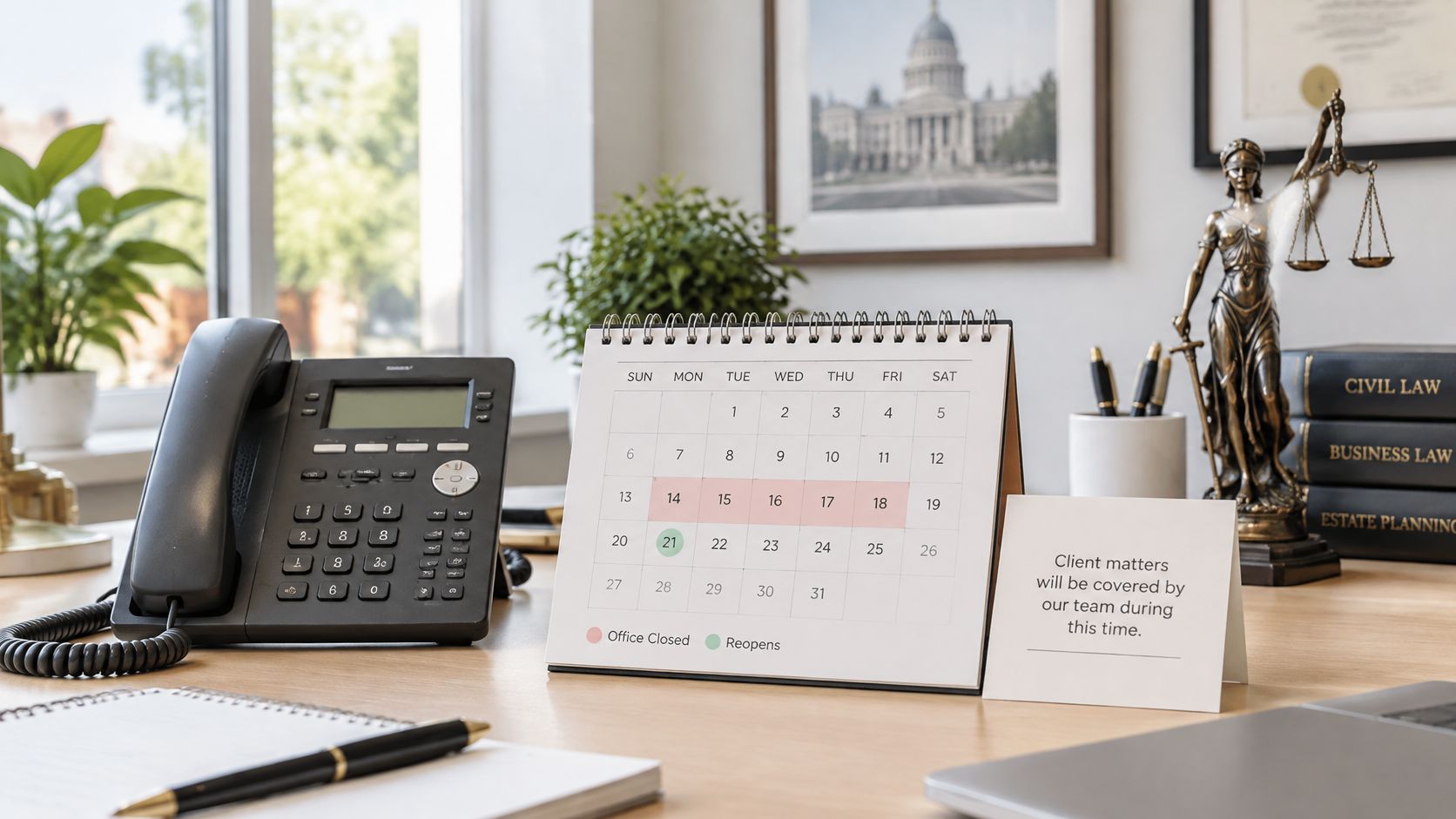
Holiday messaging has three jobs. Say when you closed, say when you reopen, and say what happens to messages left in between.
“Our office is closed for the Thanksgiving holiday from November 26 through November 28. We will reopen on Monday, December 1. If you need emergency assistance, please call 911. Otherwise, leave your name, number, and a brief description of your situation, and we will respond when we reopen.”
Both dates, every time. “Closed for the holidays” reads as indefinite, and an indefinite closure sounds like a firm that may not come back.
Set it and forget it properly
- Schedule both transitions: Most phone systems let you time a greeting to go live and to come down. Use both settings, then verify on the morning you reopen.
- Match the website: If the site says you reopen Monday and the phone says Tuesday, callers believe neither.
- Handle the odd single day: A Friday off between a closure and a weekend needs its own short message, not an extension of the holiday one.
- Give one real alternative: An answering service, an email address, or an intake line. “Leave a message” is acceptable over a holiday. “Leave a message and hope” isn’t.
The holiday greeting is also a good place to promise that new inquiries will be reviewed the day you reopen. That gives your staff a deadline they can keep and gives the caller a date to hold onto.
6. Voicemail Greeting with Call Recording and No-Advice Disclaimer
This is the greeting most firms skip and the one that protects them most.
A distressed caller will describe her injuries, the other driver’s insurer, and the fact that her brother-in-law works for that insurer, all inside ninety seconds, before anyone at the firm has agreed to speak with her. That recording now sits in a system she assumed was private.
A Virginia legal ethics opinion on voicemail confidentiality addresses the assumption directly. It states that a person leaving detailed information on a firm’s external voicemail may not reasonably expect confidentiality, and it recommends warning callers not to provide confidential or sensitive information.
Script to adapt: “Thank you for calling Harper Injury Law. This call may be recorded for quality and intake purposes. Leaving a message does not create an attorney-client relationship, and this line does not provide legal advice. Please leave your name, a callback number, the date of your incident, and a general description of what happened. Please do not share medical records, policy numbers, or details about other parties on this recording.”
Where the disclaimer goes
Put the recording notice and the no-advice line before the prompt to speak, so a caller hears it while she can still decide what to say. Then keep the intake fields narrow. Name, number, date, general description. Anything beyond that belongs in a conversation with a person.
- Check your state’s consent rule: Some states require all parties to consent to a recorded call, and that changes how the greeting must be worded. Review whether call recording is legal for your jurisdiction before you record the message itself.
- Have a licensed attorney read the wording: A disclaimer drafted by a marketing vendor is a liability with good intentions.
- Keep it consistent with your written terms: The phone and the website terms and disclosure notice should describe the same boundaries, or a caller will notice the gap.
None of this costs you a lead. A caller who understands the boundaries before she speaks is a caller who trusts the callback.
7. AI-Assisted Intake Greeting with Human Transfer Option
Automated intake changes one thing about greeting design. A recording speaks to everyone the same way. An agent that answers questions has to tell the caller what it is, and it has to offer a way out.
Disclosure comes first, before any question.
“Thank you for calling Whitfield Injury Law. Our attorneys are unavailable right now, so you’re speaking with our automated intake assistant. I’ll collect your name, contact information, and a brief summary of what happened. This line doesn’t provide legal advice. You can say representative at any time to reach a person.”
Then the part most scripts miss. Not every caller should be asked to leave a detailed message. Guidance on safe callback instructions for legal intake recommends capturing the caller’s preferred contact method, a safe callback window, permitted message content, and whether voicemail is allowed, and it warns that a callback request doesn’t authorize a detailed voicemail or prove identity.
Ask less when the caller is at risk
Someone calling from a shared phone, or from a home where a partner monitors the line, has a reason to keep the message short. A neutral callback request can be the difference between a return call and no call at all.
- Offer a low-disclosure path: A first name and a safe number is enough to start. If the caller says the phone is shared, record that and stop asking.
- Store the restriction where staff will see it: “No voicemail,” safe hours, language preference, and whether the firm name may appear in a message belong in the intake record, not on a sticky note.
- Keep the transfer one step: A caller who asks for a person shouldn’t have to retell the story to get there.
- Check the script against the flow: Read the approved greeting while listening to a test call. If the agent asks for a mailing address the greeting never mentioned, fix the script or fix the flow.
The test of an automated greeting isn’t whether it sounds human. It’s whether a caller who can’t safely explain her situation still ends the call with a way back to you.
8. Concise Professional Greeting with Name and Firm
Most calls don’t need a script. They need a name and a prompt.
The simplest message on this list survives the most situations because it promises nothing it can’t deliver. No date, no menu, no explanation of why the desk is empty.
Script to adapt: “You have reached Alex Morgan at Morgan & Diaz Injury Law. I am away from my desk. Please leave your name and number, and I will return your call as soon as possible.”
A plain prompt still works for a large share of people. In 2025, 42% of 1,000 U.S. consumers surveyed by CallRail said they would leave a voicemail when a business didn’t answer, according to RedialBPO’s analysis of what a missed call costs. The other 58% won’t, which is why the short greeting needs a partner: a website form, a text-back, or an answering service.
Where the short greeting fails
It fails whenever the caller can’t tell whether anyone will ever call back. Pair it with a written timeframe on the firm website or the intake form, and the message stops sounding like a dead end.
- Record it on a real handset: A voice captured through a laptop microphone sounds thin over a phone line. Call your own number and listen before you save.
- Put the instruction last: Callers remember the final sentence. End on “leave your name and number,” not on the firm’s street address.
- Use it as the default: Switch to a dated message for travel, a menu for after-hours, and this one for everything else.
- Say the firm name slowly: It’s the one piece of information a rattled caller is most likely to mishear.
A short greeting recorded well and backed by a callback is worth more than a polished script that nobody answers.
Which out of office phone greeting fits your situation
| Greeting | Best For | Key Elements | Ideal Length |
|---|---|---|---|
| Standard Away Greeting with Return Date and Alternate Contact | Setting expectations while an attorney or staff member is away | Firm and caller-line identification, unavailability, return date, alternate contact | Under 20 seconds |
| After-Hours Intake Greeting with Options | Collecting and triaging calls when the office is closed | Office hours, brief menu, intake voicemail, emergency instructions if needed | Short; limit to two or three options |
| Emergency-Routing Greeting for Urgent Matters | Directing callers with immediate medical, safety, or time-sensitive needs | Emergency instructions first, urgent-call route, voicemail option for other matters | Short and clear |
| Overflow Coverage Greeting for Busy Teams | Managing calls when staff are assisting other clients | High-call-volume notice, callback timeframe, requested intake details | Brief, with a realistic callback timeframe |
| Holiday and Office Closure Greeting | Planned holidays, retreats, or extended closures | Closure dates, reopening date, available coverage, emergency instructions | Brief, with exact dates |
| Voicemail Greeting with Call Recording and No-Advice Disclaimer | Notifying callers about recording and setting legal expectations | Recording notice, no attorney-client relationship disclaimer, no-advice statement | Brief; keep disclaimers easy to understand |
| AI-Assisted Intake Greeting with Human Transfer Option | Firms using an automated assistant for after-hours or overflow intake | AI disclosure, information collected, human-transfer option, no-legal-advice notice | Brief, with the human option stated clearly |
| Concise Professional Greeting with Name and Firm | Everyday voicemail or a simple default greeting | Name and firm, unavailability, clear request to leave a message | About 10 to 15 seconds |
Pick One Greeting, Then Test It Tonight
Start with the absence that costs you the most. For most plaintiff firms that’s the evening and weekend gap, so switch on the option menu first, then rewrite the standard away message so it carries a return date and a second route. Firms with a clogged midday queue should schedule the overflow greeting for their two or three heaviest hours and leave the rest of the day on the standard message.
Record it, then call your own line from a phone that isn’t on the office system. Listen for the pause before the beep, the length of the menu, and whether the instruction to leave a message arrives before a caller’s patience runs out. Most firms hear something they didn’t expect: a greeting that runs 40 seconds, a return date from last month, a press-2 option that rings a disconnected extension.
Then leave it alone for two weeks and count. Four numbers matter: after-hours calls received, messages completed, callbacks that connected, and matters signed. Compare the two weeks before the change with the two weeks after. If completed messages rise while callback success doesn’t, the problem is follow-up, not wording. If both fall, the greeting is asking for more than a rattled caller will give.
Set the calendar reminder the day the recording goes live, and check messages by 9 a.m. every morning. Those two habits do more for your phone line than any script revision. Add a quarterly review so a holiday message never survives into February.
Firms that want a caller to reach someone at 11 p.m. without staffing a night shift have another option. Lighthouse Legal’s AI receptionist answers your line around the clock, screens callers against your intake criteria, and transfers qualified callers directly to your team, and firms using it keep their staff on daytime calls while evenings and weekends are covered. You can call the demo agent at +1 (681) 376-0380 to hear how an automated intake call sounds before you change your own greeting.
Lighthouse Legal builds AI voice agents for personal injury firms that answer incoming calls day and night, gather intake details using the firm’s own screening questions, and pass qualified callers to the team as soon as they qualify. If your greeting is currently doing more work than your staff can follow up on, compare it against a live example at Lighthouse Legal and hear the difference on a real call.