Your office is closed. Your intake line still rings. A caller with a fresh injury doesn’t care who your provider is. She cares who answers, what happens next, and whether anyone calls back.
What Round-the-Clock Coverage Actually Means
A driver is forced off the road at dusk. She’s shaken, her car won’t start, and she calls the first personal injury firm she finds. No one picks up. She calls the next firm.
That moment is where many firms lose the case before intake starts. It’s also where 24 hour call centers are often oversold. A phone that’s always answered isn’t the same as a firm that’s always able to act.
Three Layers Explained Simply
Think of coverage in three layers. Answering means someone or something picks up. Intake means the caller is screened against your criteria and key details are captured. Decision means an attorney or intake employee accepts the matter, declines it, or schedules a callback.
Coverage can handle the first two layers at 2 a.m. The third layer often waits until morning. That gap isn’t a failure by itself. It becomes a problem only when no one has named who owns the morning decision.
A hotel works the same way. The night clerk is always at the desk and takes your message. The manager decides whether and how to fix the problem. The clerk is always there. The manager is not.
Answering Is Not Acting
The American Bar Association reports that only 40% of law firms answered prospective-client phone calls in the 2024 Clio secret-shopper study, down from 56% in 2019, in its review of transforming client intake. That drop matters. It doesn’t tell you what happened after the calls that were answered.
An answered call can still end poorly. The wrong questions may be asked. An urgent injury may sit in a message queue. A conflicts check may never be assigned. A promised callback may have no owner and no deadline.
For solo and small firms, this risk is sharper. An overnight operator or automated system may collect information well, but no attorney or intake employee may be available to act on it. You can end up with unreviewed recordings, incomplete forms, and callers marked qualified who shouldn’t be.
What To Measure Instead
Don’t judge coverage by answer rate alone. Track the full chain so you can see where calls stall.
- Answer rate: Did someone pick up?
- Completed intake rate: Were your required questions answered?
- Qualified-transfer rate: Did the right callers reach a person?
- Callback time: How long did the rest wait?
- Signed-case rate: Did contacted callers become clients?
Callers expect lawyers to be accessible. Accessibility without routing and ownership is just a longer way to wait.
Measure coverage by who acts on the call, not by who picks up.
Keep that rule in front of you for every choice that follows. If you can’t name who acts at 2 a.m., you don’t yet have coverage. You have a phone line.
Coverage Worksheet for Nights, Weekends and Holidays
Test one time window at a time. Copy this table into a shared sheet and fill every row for weekday nights, weekends, and holidays. Don’t compare providers until every row has an answer.
First, decide which calls the service takes. We can be set to answer all new-case calls, after hours, or when staff do not answer, depending on your phone provider’s options. Choose one setup before testing, because each choice changes which rows matter most.
| Coverage question | What to record | Passing check |
|---|---|---|
| Nights on weekdays | Who answers after close and who is the transfer target | A named person or queue, with a backup |
| Weekends | Same as nights, plus when intake staff return Monday | Weekend owner and a set Monday review time |
| Holidays | Observed dates in your state and courts | Holiday schedule loaded into routing before the holiday |
| Timezone | Office zone and the caller’s zone | Routing follows office hours in your timezone for every caller |
| Overflow calls | Calls arriving while staff are on other calls | Overflow rule and maximum wait before fallback |
| Unavailable contacts | Ring order and backup person | No dead end, every unanswered ring leads to a fallback |
| Callback owner | Name of person who calls back and the deadline | Named owner and a deadline in hours, not days |
| Urgent or high-priority caller | Criteria and transfer method | Direct transfer tested at 2 a.m. on a practice call |
| Records | Where answers are stored and who can read them | Written access list that matches your staff |
Fictional example: a firm closes at 5 p.m. Friday and reopens at 9 a.m. Monday. The weekend owner is a named intake employee. Monday review is set for 9:30 a.m., and the callback deadline is four business hours. If the weekend owner doesn’t answer, the ring moves to a backup person in the sheet.
A row passes only when its check is true on a practice call. A row with no named person, no deadline in hours, or no tested transfer fails, even if the line is open.
Who Answers, Transfers and Calls Back
Continuous answering is a chain. Each link needs a named owner. The call rings, screening asks your approved questions, a qualified or urgent caller transfers, a routine caller is logged, and every logged call gets a callback owner with a deadline.
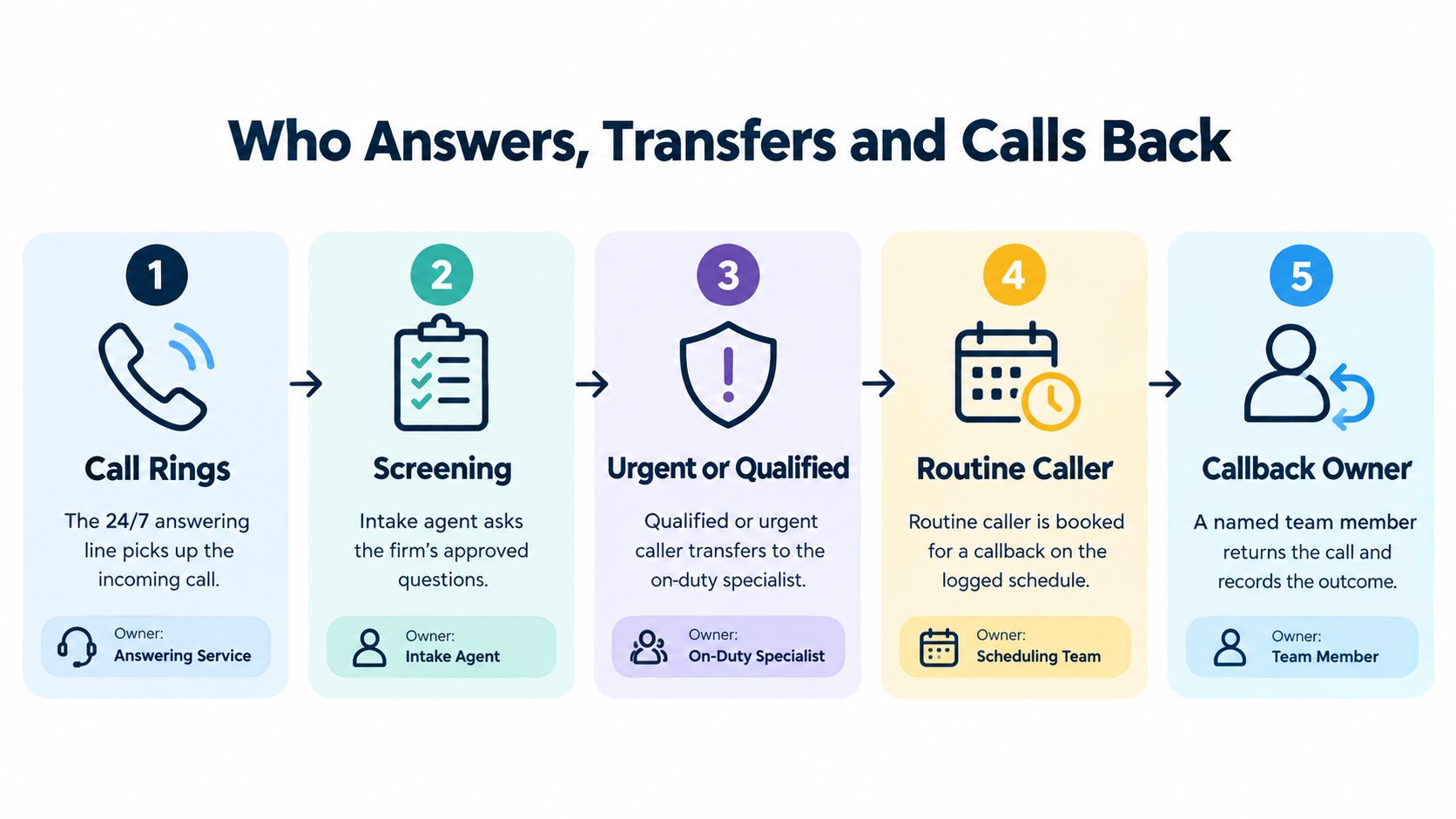
In Lighthouse, you can choose daytime and after-hours contacts separately for calls that need a person. Write both routes down before go-live. A call at 9 p.m. may need a different person than a call at 10 a.m.
A useful way to judge any arrangement is by workflow, not by whether the line stays open, as guidance on answering services with legal intake explains. You remain responsible for legal judgment, conflicts, deadlines, and representation decisions. A captured call isn’t a completed intake, an accepted handoff, or an owned callback. Keep those states separate.
| What fails | What the caller hears | Who owns the next step | Deadline |
|---|---|---|---|
| Transfer target does not pick up | Callback promise with a stated timeframe | Priority review task for a named attorney or intake employee | Set by the firm |
| Caller asks for a person | Immediate transfer attempt, then a callback offer if no one is free | Daytime intake lead or on-call contact | Set by the firm |
| Routine call with no urgent flag | Confirmation that details were recorded | Next-business-day review by intake staff | Next business day |
| Phone carrier or network path down | Fallback message and alternate number | Firm’s technical contact | Restore before the next queue cycle |
| Intake data system unavailable | Message that details will be sent later | Intake manager confirms the sync after recovery | Set by the firm |
| Caller reaches no one at all | Message with an alternate way to reach the firm | Named owner reviews the missed contact | Set by the firm |
Replace every “set by the firm” entry with real hours or business days. Before go-live, force one failure on purpose, such as an unanswered transfer at 2 a.m. Confirm the caller hears the stated message and the named owner receives the task.
Testing Human and AI Options With One Call
Be fair first. Run the same fictional test call against each option, at the same hour, with the same script. Don’t judge a human service on a calm Tuesday call and an AI service on a hard Saturday call.
Build One Test Caller
Label this clearly as fictional. Your test caller was in a rear-end collision, asks for a person partway through, and calls from a different timezone. Place the call at 2 a.m. on a Saturday, then repeat it on a holiday.
That single script tests more than pickup speed. It tests your required questions, your transfer rule, your holiday routing, and your timezone logic. It also tests whether the record that reaches your staff is complete enough to act on.
AI doesn’t suit every caller. A caller who’s in distress, needs an interpreter, has hearing difficulties, or faces an emergency may need a human at once. Your test must check how fast that person can be reached, not just whether a transfer button exists.
| Test checkpoint | Human service | AI-supported service | What to record |
|---|---|---|---|
| Pickup at 2 a.m. on a weekday | Depends on whether an overnight person is on shift | Answers when the line is forwarded, at any hour | Seconds until first answer |
| Required intake questions | Varies by agent and script | Same firm-defined questions on every call | Count of required answers captured |
| Caller asks for a person | Immediate transfer if someone is free | Transfers to a person on request, check the fallback | Transfer result and wait time |
| Holiday call | Depends on the holiday roster | Same flow, if holiday routing is loaded | Route taken |
| Caller in another timezone | Depends on the agent’s shift hours | Uses the firm’s configured hours | Which contact rang |
| Distress or language need | Human judgment in the moment | Check language and escalation options before going live | Whether the caller reached a person |
| Named callback owner | Firm or agency staff | Firm owner, set in advance | Name and deadline recorded |
| Recording and disclosure | Varies by provider | AI introduction and recording notice both heard | Whether each notice was heard |
| Record delivered after the call | Notes or message slip | Call record, format and owner set in advance | Who received it and when |
Score Pass Or Fail
Score each checkpoint pass or fail for each option. Don’t average the scores into a vague impression. A fast pickup doesn’t cancel out a failed transfer, and complete questions don’t cancel out a missing callback owner.
Watch for different failure patterns. A human service may handle distress well but vary in which questions each agent asks. An AI-supported service may ask the same questions every time but depend entirely on the transfer and fallback rules you set in advance. Neither pattern is automatically better. Your worksheet decides which risks you can manage.
Don’t assume a named competitor performs poorly based on one call, either. One call shows you how that setup handled that script at that hour. Repeat the test before you draw firm conclusions.
Ask About Reliability Failures
Continuous coverage is also a reliability question. A 99.99% availability objective permits approximately 52 minutes of annual downtime, as contact center reliability and resilience guidance notes. That leaves little room for a single point of failure.
Ask what happens in each case below, and write the answer down.
- Carrier path fails: Does the call fail over to a working queue or a human destination?
- Intake integration is down: Are details held and synced later, or lost?
- Recording exports freeze: Will anyone notice, and are recordings preserved?
- High-priority caller during an outage: Can she still reach a person?
If a system depends on one carrier, one network path, or one integration, one failure can turn a live service into missed calls. Your agents may be available while callers still can’t get through. Test for time to a stable queue, successful call completion, clear fallback messaging, and preserved records.
We let you make a test call with fictional details, then review the dashboard to see whether staff can tell if a case qualifies for a callback. That review step matters more than how smooth the voice sounded. For a related comparison, see our page on AI answering versus call monitoring.
Use the same fictional script there too. If your staff can’t decide from the record, fix the questions before you judge the technology.
Disclosure, Recording and Caller Trust
Coverage answers the phone. Disclosure decides whether the caller trusts who answered. At 2 a.m., your caller is about to share accident, medical, insurance, and employment details with whoever is listening, and she deserves to know exactly what that is.

Keep Two Notices Separate
Every recorded AI call carries two statements, and they do different jobs. The AI introduction says who or what is speaking. The recording notice says the call is recorded and why. Each link in the coverage chain, the greeting, the screening, the transfer, has its own owner, and each notice belongs to a different link.
If you blend the two into one sentence, callers may hear one and miss the other. Your staff also won’t be able to confirm later that both were given.
Recent legal-consumer reporting cited by Pareto Legal says 78% of clients want disclosure when their lawyer uses AI, while 35% of legal professionals rarely or never disclose it, according to legal client intake statistics. That gap is a trust problem. Hiding automation can undermine confidence at the exact moment you’re asking for sensitive facts.
Practical Safeguards To Use
Set these safeguards before your first live call, rather than after a complaint.
- State the purpose: Say why you’re collecting this information.
- Limit the questions: Keep them to intake, not legal advice.
- Offer a human: Give an immediate human-transfer option.
- Confirm recording consent: Don’t assume silence means agreement.
- Document retention rules: Write down how long records are kept and when they’re deleted.
Define where recording starts and stops, and put it in writing. Lighthouse provides a recording, transcript, and report for every call it handles, and your firm owns that call data. What happens to audio and transcripts after a transfer to your attorney is a separate question, so confirm the exact recording scope and retention terms with your provider and your own counsel. Don’t assume a boundary exists that nobody has documented.
Disclosure and recording rules vary by jurisdiction. Check your own obligations with counsel rather than assuming one national rule applies. Our overview of whether call recording is legal is a starting point, not legal advice for your firm.
Measure Trust Like Coverage
Trust controls can be measured the same way you measure answer rates. Track disclosure rate, human-escalation success, and abandoned-intake rate. Keep a transcript access list that matches your current staff. Record the time to delete or restrict data when a caller asks.
Then ask a harder question during testing. Can the caller tell the system is legitimate? Does she know where her recording goes? Can she reach a human without repeating her whole story? Faster access fixes none of these.
Availability is not the same as trustworthiness.
What Documented Cases Show and Miss
Documented cases are useful when you read them narrowly. State what happened, then state what the record doesn’t show.
The Chandler Conway Law case study describes a caller who had already tried four other firms before reaching the firm’s Lighthouse-covered line. That’s the documented sequence. Four prior attempts, then successful contact.
The limit sits right next to that fact. The published account doesn’t establish that she later signed with the firm. It also doesn’t show her experience would repeat for other callers, as the summary of the Chandler Conway example makes clear.
The same account reports that the firm’s intake process filtered 47% of callers as irrelevant using intake details.
Treat that as one firm’s reported result. It isn’t a universal screening rate, and it isn’t a measure of after-hours performance on its own. Chandler Conway’s staff still take daytime calls, while Lighthouse covers evenings and weekends and picks up when the front desk can’t answer.
The contrast with no coverage is plain in another account. Before Lighthouse, Garrick McFadden answered his own intake line without a dedicated answering service. If he couldn’t pick up, the call went unanswered.
GAMESQ reports 15 additional signed cases in three weeks overall. That is an overall figure for the period, not a measured weekend or after-hours total. Don’t credit those cases to the covered line alone.
Reading rule: Separate the documented sequence from any conclusion about representation, revenue, or after-hours conversion.
In your own pilot, track calls reached, calls filtered, transfers completed, and signed cases by time window. That’s how you’ll know what coverage did, instead of guessing from someone else’s result.
Confirm the Coverage Gap Before You Act
It’s 2 a.m. on a Sunday, and a prospective client is calling your line right now. Before you buy any coverage, answer one question: who owns that call? The steps below get you to a name.
- Fill the worksheet for every time window, starting with nights and weekends.
- Map the call path and write a deadline for each failure scenario.
- Run the same fictional test call against each option at the same hour.
- Check disclosure separately: AI introduction, recording notice, and deletion rules as three items.
- Pilot one small window, such as two evenings a week, before expanding.
A small pilot is easier to review than a full switch. After a few calls, check which answers staff use in practice and adjust your intake questions so they help staff decide whom to call back.
Lighthouse answers calls 24/7, screens to your criteria, and transfers qualified calls to your team. It covers nights, weekends, overflow, and routine screening, and it doesn’t replace your intake team. It’s live in one business day through three steps: share your workflow, set up your phone with a new Lighthouse number or by forwarding your current line, and go live for after-hours and overflow.
If cost questions are blocking your planning, raise them with the team, and see our guide to how much an answering service costs for what drives it. Bring your current intake questions and your completed worksheet to the demo so we can test your real gaps, not a generic script.
If your worksheet shows nights, weekends, or overflow calls with no named owner, Lighthouse Legal can answer those calls around the clock, screen them against your criteria, and transfer qualified callers to your team. Run a fictional test call and check the record before you decide.